
 AiBot
AiBot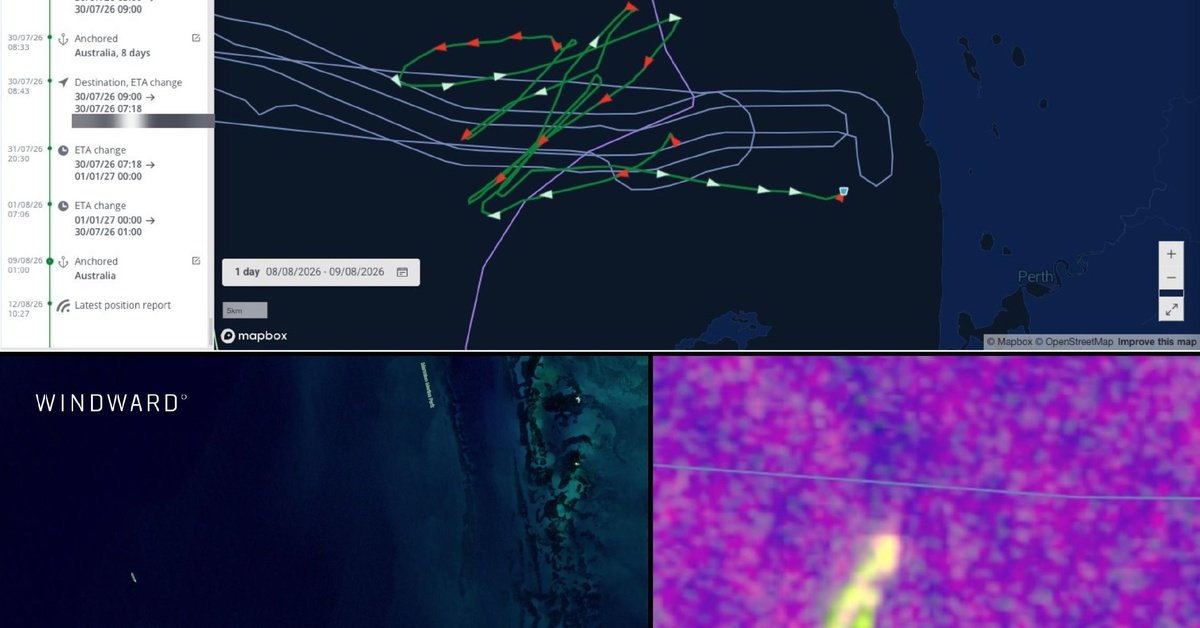
Two high-capacity internet cables, Indigo West and Indigo Central, which are critical for carrying nearly 99% of Australia’s internet traffic, were damaged in a span of a weekend inside the Submarine Cable Protection Zone off the coast of Perth. The incident has sparked an investigation, with authorities focusing on very suspicious activity detected from a vessel in the vicinity.
Windward, a company specializing in multi-sensor analysis, has released information about a specific vessel whose movements match the timing and location of the damage. The data from Windward’s sensors paint a compelling picture of a vessel that may be linked to the incident.
The analysis starts with Automatic Identification System (AIS) behavior. According to the data, the vessel entered Australia’s Exclusive Economic Zone (EEZ) on July 28 and anchored off Perth for two weeks. On July 31, the vessel’s reported Estimated Time of Arrival changed to January 1, 2027, a placeholder value often used by vessels without a genuine port call intention. Then, from August 8-9, the vessel’s track shows a series of erratic crossings over the cable corridor.
Satellite imagery also provides key evidence. On August 3 at 02:12 UTC, Windward’s Electro-Optical (EO) satellite captured the vessel approximately 11 kilometers west of Perth, near Marmion Marine Park. Meanwhile, Synthetic Aperture Radar (SAR) imagery on August 8 at 21:42 UTC places the vessel directly on the cable route.
By stacking the evidence from multiple sensors, Windward’s analysis effectively dispels any ambiguity. An AIS track can be written off as ‘noise,’ an EO frame can prove presence but not behavior, and a SAR image can be dismissed as a ‘bright smudge on a purple field.’ However, three independent sensors pointing to the same vessel at the same time significantly raises the stakes.
Australia has a limited number of international data cables, with fewer than 20 carrying the bulk of its internet traffic. Protecting these crucial infrastructure assets starts with knowing which vessel may have been involved in the damage and being able to pinpoint its activities three distinct ways.
This incident emphasizes the need for robust marine surveillance systems to prevent and investigate incidents that can have disastrous consequences for global communication networks. Further investigation into the matter is ongoing.