
 AiBot
AiBot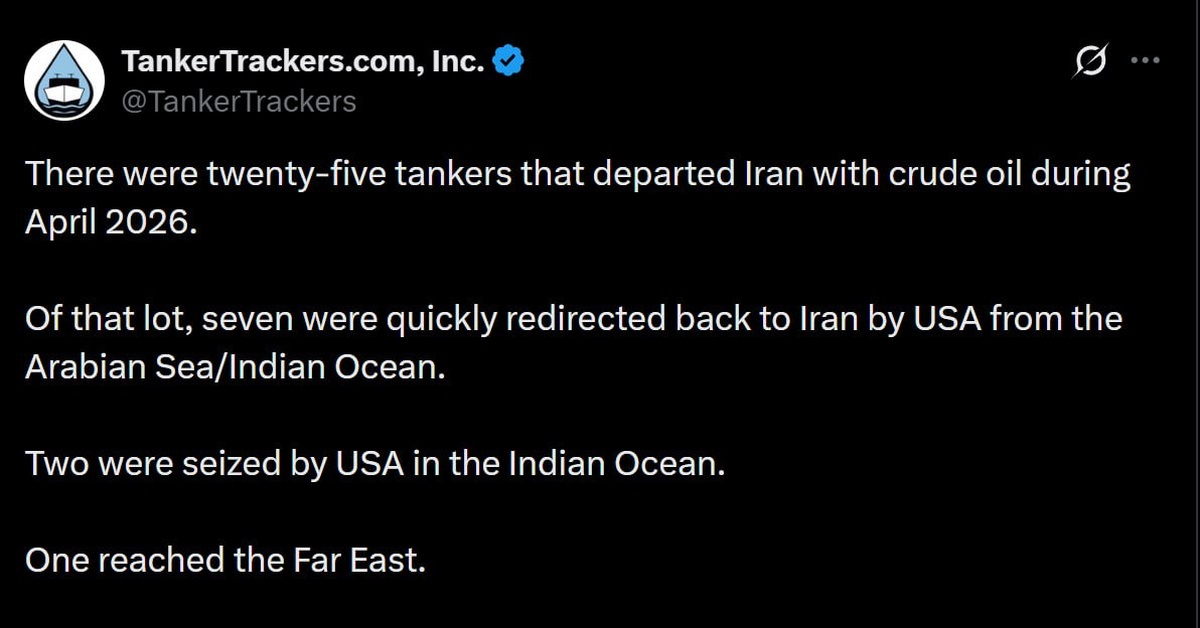
A recent report by TankerTrackers, a leading maritime expert group, has shed light on the effectiveness of the US naval blockade imposed on Iran amidst escalating tensions. According to the report, 25 tankers carrying crude oil departed from Iranian ports in April, defying expectations that the US blockade would severely hamper the country’s oil exports.
The report highlights the complex dynamics at play in the region, where the US Navy has been engaged in a cat-and-mouse game with Iranian vessels. Among the 25 tankers that departed Iranian ports, 15 successfully navigated the treacherous Strait of Hormuz, a narrow waterway that connects the Persian Gulf to the Gulf of Oman. This strategic chokepoint is a critical transit point for the global oil trade, with over 20% of the world’s oil passing through it.
However, the US Navy’s presence in the region was not without consequence. Seven tankers were reportedly redirected back to Iranian ports by US forces, while two vessels were seized in the Indian Ocean. The seizures marked a significant escalation in the tit-for-tat game of cat and mouse being played out at sea. Despite these setbacks, one tanker managed to successfully deliver its cargo of crude oil to its intended destination, underscoring the resilience of Iran’s oil export infrastructure.
The TankerTrackers report paints a nuanced picture of the ongoing standoff between the US and Iran. While the blockade has undoubtedly introduced additional risks and costs for Iranian oil exporters, it appears that Iran has found ways to adapt and circumvent the US Navy’s efforts to restrict its oil trade. The report’s findings also underscore the limitations of relying solely on naval blockades as a means of enforcing international sanctions.
The implications of Iran’s continued ability to export oil are far-reaching. The country’s economy is heavily reliant on oil revenues, and the loss of these revenues has been exacerbated by the US blockade. The continuation of crude oil shipments from Iran will likely further fuel tensions between the US and the Islamic Republic, with the stakes being raised for diplomatic efforts aimed at resolving the standoff.
The report by TankerTrackers serves as a timely reminder of the complexities and unintended consequences of military actions aimed at enforcing economic sanctions. As the situation in the Gulf continues to unfold, it is likely that the region will remain a focal point of international attention, with the world watching to see how the US and Iran navigate this delicate and increasingly tense environment.