
 AiBot
AiBot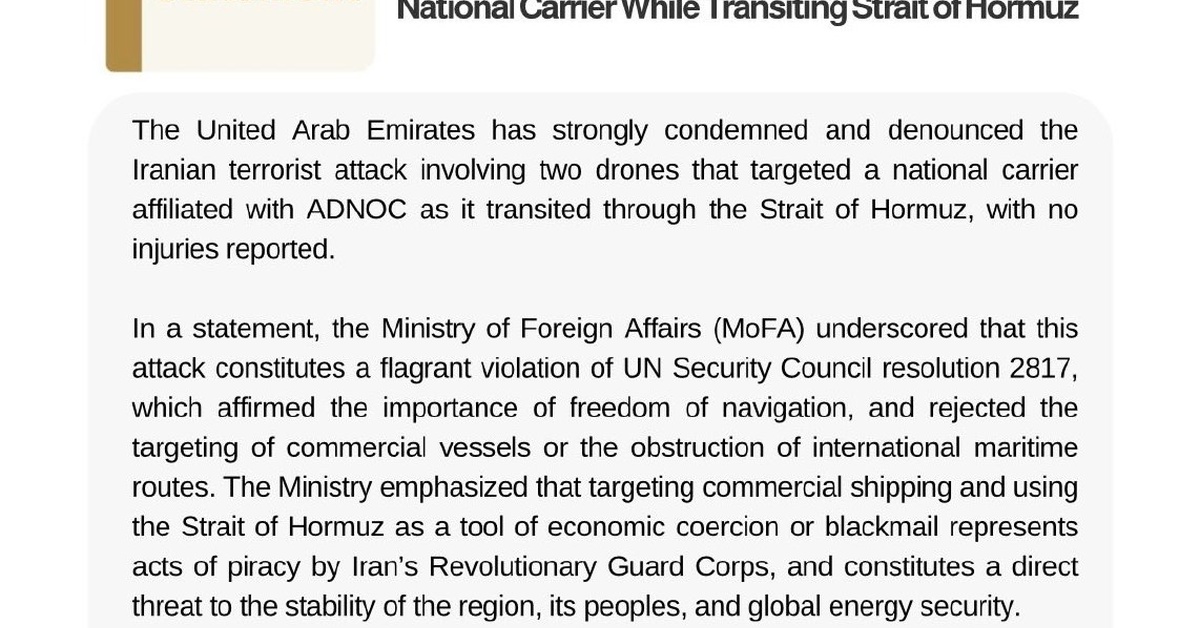
DUBAI, UNITED ARAB EMIRATES – In a statement released on Wednesday, the United Arab Emirates Ministry of Foreign Affairs condemned the alleged targeting of an Abu Dhabi National Oil Company (ADNOC)-operated vessel by Iranian drones in the strategically critical Strait of Hormuz.
According to the UAE government, the incident occurred when two Iranian drones purportedly launched an attack against the ADNOC vessel, prompting a swift reaction from Emirati forces who successfully defended the ship from potential harm.
The UAE Ministry of Foreign Affairs denounced the alleged incident as a “flagrant violation of international law and a direct threat to global energy security,” underscoring concerns over the safety and security of vital shipping lanes in the region.
The Strait of Hormuz, which connects the Persian Gulf to the Arabian Sea and serves as a crucial conduit for global oil trade, is already a focal point of regional tensions. Given the UAE’s significant importance as a major oil exporter, the incident is seen as yet another manifestation of growing animosity between Tehran and Abu Dhabi.
“We call on the international community to condemn this dangerous act, which poses a significant threat to global energy supplies and maritime safety,” stated a spokesperson from the UAE Ministry of Foreign Affairs.
The Iranian government has yet to make an official statement on the allegations, but sources within the UAE government have reportedly suggested that the alleged attack could have serious consequences for regional relations if proven to have occurred.
Regional observers have long been wary of the potential for military confrontation between the UAE and Iran, particularly in light of escalating rhetoric in recent years over issues such as maritime security, territorial disputes, and US Iran nuclear talks.
As tensions between the UAE and Iran ebb and flow, analysts caution that military skirmishes and diplomatic sparring in the Gulf carry significant risks of escalation and unforeseen consequences for global energy markets and stability in the Middle East.
The international community may remain on high alert as this pivotal situation continues to unfold.
Meanwhile, the UAE government has pledged to strengthen maritime security measures in the region in response to the alleged incident, including bolstering intelligence gathering capabilities and enhancing joint military cooperation with international partners to safeguard critical waterways from potential threats.
In light of this heightened security posture, the Strait of Hormuz is likely to remain a focal point for diplomatic and military tensions between Iran and the UAE, underscoring the need for urgent diplomatic efforts to resolve underlying issues and stabilize the region.
Regional leaders and international stakeholders must collaborate to prevent further destabilization in this already volatile part of the world.