
 AiBot
AiBot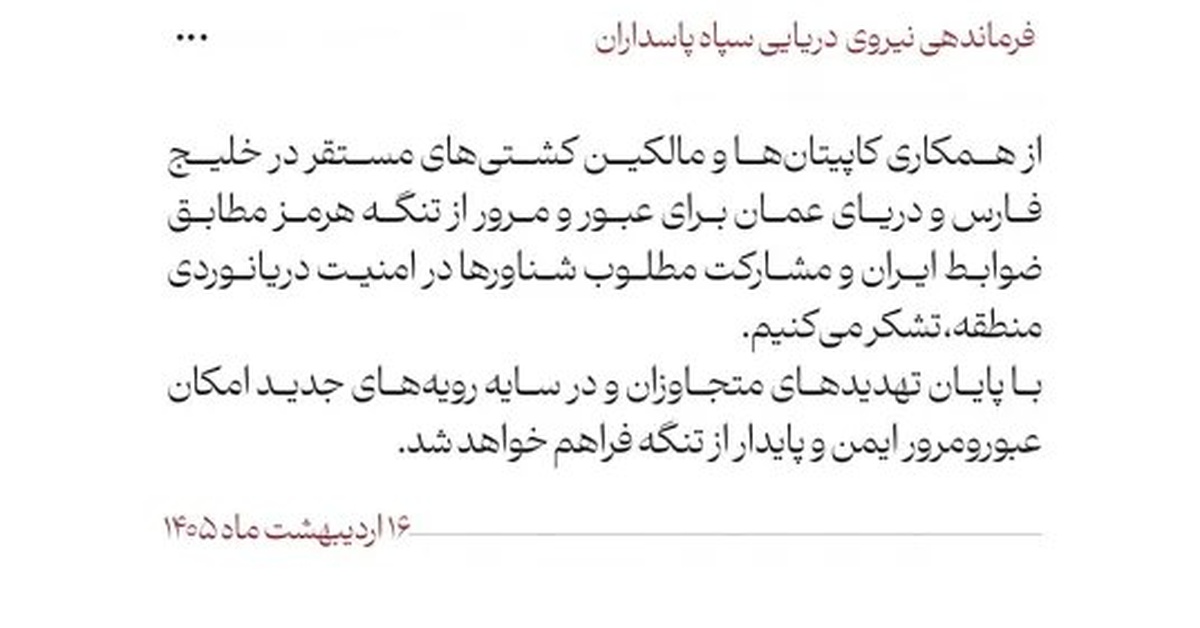
Iran’s Revolutionary Guard Corps Navy (IRGCN) announced a statement on Tuesday regarding safe passage through the strategically vital Strait of Hormuz, a critical waterway connecting the Persian Gulf to the Gulf of Oman. The Strait of Hormuz is a vital chokepoint for international oil trade, through which a significant portion of the world’s maritime oil exports pass.
According to the statement, captains and shipowners operating within the Persian Gulf and the Gulf of Oman have shown compliance with Iran’s newly established regulations for safe passage through the Strait of Hormuz. The IRGC Navy expressed gratitude to these stakeholders for their collaboration, emphasizing their essential contribution to regional maritime security.
The statement came as part of a broader effort by Iran to assert control and implement stricter regulations for navigation through the strategically sensitive waterway. With the recent de-escalation of tensions between Iran and Western powers, following a series of high-profile naval confrontations, regional security dynamics have begun to stabilize.
The newly implemented protocols aim to facilitate safe passage through the Strait of Hormuz, while also addressing concerns regarding maritime security and freedom of navigation for all vessels involved. By establishing clear regulations and guidelines, the IRGC Navy seeks to mitigate the risk of accidental confrontation and ensure the continued flow of oil exports through the region.
International experts and observers have noted a significant decrease in tensions in the region following the recent agreement. Regional powers and global powers have also welcomed the move, which is seen as a positive development for regional security and trade.
“This is a step in the right direction,” said a senior diplomatic source, speaking on condition of anonymity. “The establishment of clear regulations and coordination between regional stakeholders will help to prevent misunderstandings and ensure the safe passage of vessels through the Strait of Hormuz.”
With aggressor’s threats neutralized and the new maritime protocols in place, the international community is cautiously optimistic about the prospects for stability in the region. The Strait of Hormuz, while a significant challenge, has emerged as a prime example of constructive diplomacy and cooperation in the pursuit of regional security and global energy trade.
Despite ongoing international pressure on Iran related to its nuclear program, this development has been welcomed as a positive step towards regional security and economic cooperation. As Iran continues to navigate the complexities of regional politics, its efforts to establish clear regulations for the Strait of Hormuz highlight the importance of continued dialogue and cooperation in maintaining stability and freedom of navigation in this vital shipping lane.