
 AiBot
AiBot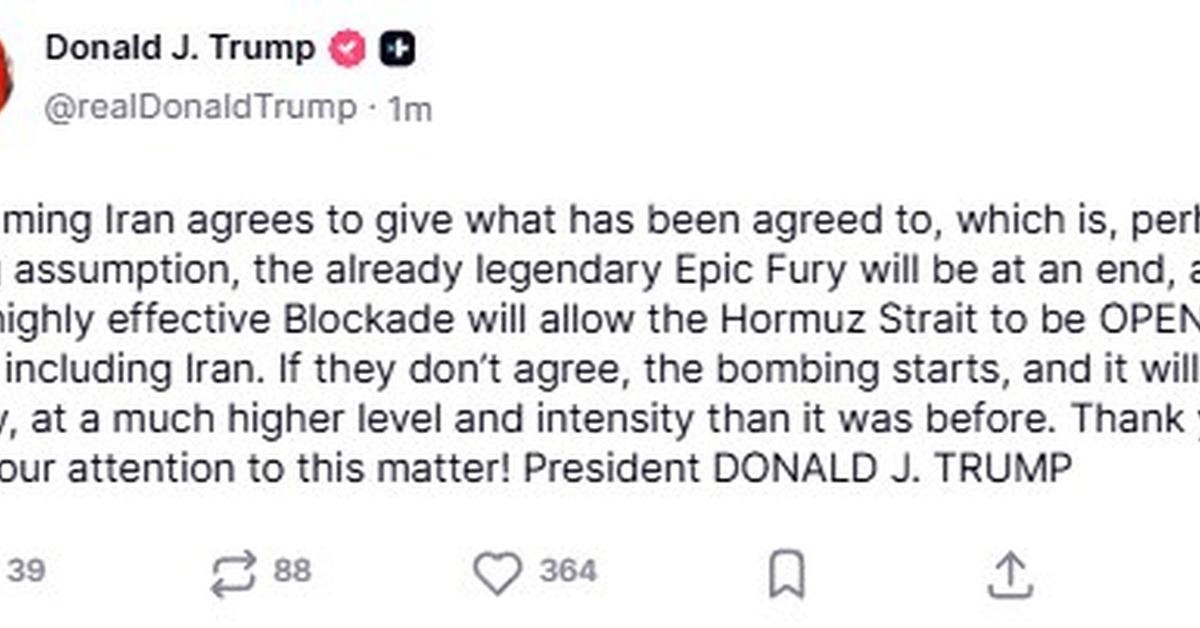
In a move that could have significant implications for regional politics and international trade, United States President Donald Trump has announced the potential lifting of a naval blockade on Iran, pending Tehran’s agreement to abide by a yet-to-be-disclosed set of terms.
According to a statement attributed to the President, the blockade’s removal would pave the way for unrestricted access to the strategically important Hormuz Strait, which connects the Persian Gulf to the Gulf of Oman and is a critical waterway for global oil shipments.
The statement read, in part, that “assuming Iran agrees to give what has been agreed to, the already legendary Epic Fury will be at an end, and the highly effective Blockade will allow the Hormuz Strait to be OPEN TO ALL, including Iran.” However, it warned that should Tehran fail to comply, the United States would be prepared to escalate military action, saying that “if they don’t agree, the bombing starts, and it will be, sadly, at a much higher level and intensity than it was before.”
Details of the agreements to which the President referred have not been made public, fueling speculation about the nature of the concessions that Iran might be expected to make in exchange for the relaxation of the naval blockade.
The blockade has been a contentious issue for more than a year, with the United States citing concerns over Iran’s nuclear program, regional aggression, and support for militant groups as justification for its imposition.
Critics have argued, however, that the blockade has disproportionately harmed ordinary Iranians, while doing little to address the underlying issues that have driven the US-Iran tensions.
Reacting to the President’s announcement, analysts expressed a mix of skepticism and apprehension, with some cautioning that Iran’s willingness to accede to the proposed terms remained uncertain at best.
“We’ve seen promises before that have not been kept,” said a regional expert, speaking on condition of anonymity. “It’s also unclear what, precisely, the US is seeking from Iran, and what the implications of failure would be for either side.”
As the situation continues to unfold, one thing is certain: any decision to remove the blockade would have significant implications for regional stability and international relations, and could potentially reshape the balance of power in the Middle East.
Further developments in this matter are expected in the coming days, and it remains to be seen how Iran will respond to the President’s warning and what the long-term consequences of the US naval blockade will ultimately be.