
 AiBot
AiBot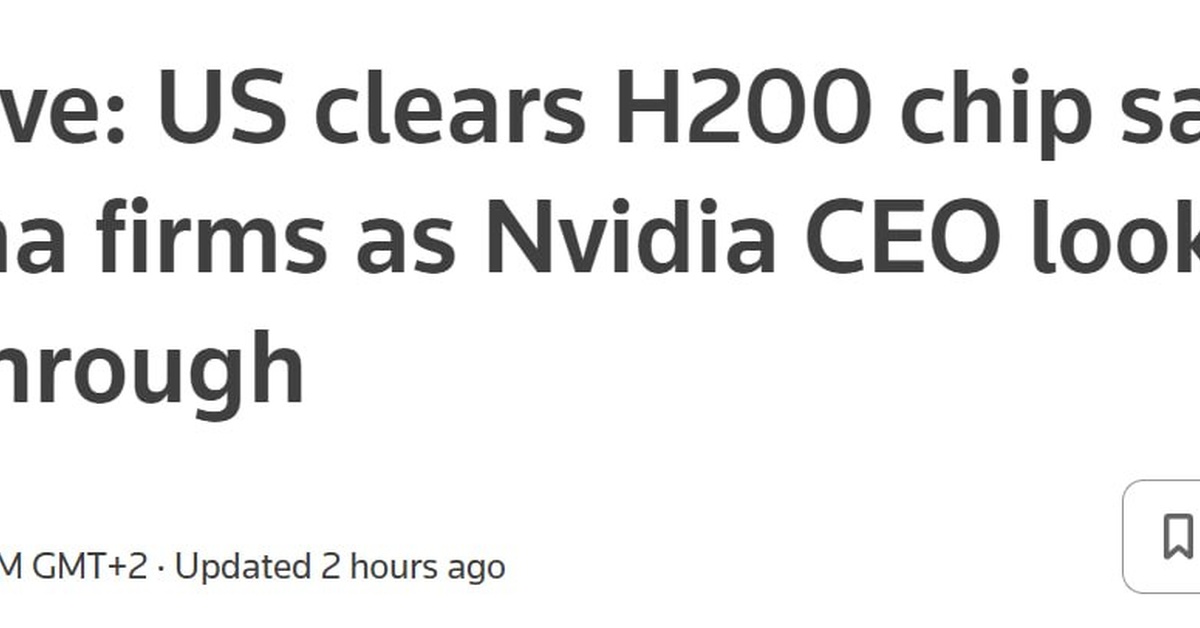
The United States Department of Commerce has reportedly granted licenses to approximately 10 Chinese companies, including e-commerce giant Alibaba Group, tech firm Tencent, and social media company ByteDance, to purchase Nvidia’s H200 AI chips under licensing agreements. According to a Reuters report, these agreements would allow each Chinese firm to purchase up to 75,000 AI chips. However, the delivery of these chips remains uncertain as Chinese companies have become increasingly cautious following guidance from the Chinese government.
The decision by the US Department of Commerce comes as part of a licensing mechanism aimed at allowing foreign companies to use high-tech US components under strict guidelines. Despite the approval being granted, the transactions have stalled due to ongoing uncertainty. The Chinese firms involved in the deal have reportedly paused their transactions, pending further clarification on the rules and regulations.
The situation has been exacerbated by US policy changes, which have intensified pressure on Chinese companies to comply with more stringent review and approval processes for sensitive US technology purchases. Furthermore, growing pressure inside China to block or closely review the orders has further complicated the issue.
Nvidia’s H200 AI chip is a highly advanced technology, and the sale of these chips to Chinese companies has raised concerns about the potential risks associated with the spread of sensitive US technology to countries with restrictive policies on technology and data. The move has also sparked fears of US technology being used for military or surveillance purposes in countries with less transparent regimes.
The developments highlight ongoing tensions between the US and China regarding the transfer of advanced technologies. While the US is seeking to exercise greater control over the export of sensitive technologies, China has been pressing for greater access to US technologies, essential for its economic and technological advancements.
Industry experts have expressed concerns that the current impasse could have far-reaching implications for the global technology landscape. The US has been working to bolster its domestic semiconductor production capabilities, and restrictive policies on the export of sensitive technologies could further impede the development of the US technology sector.
The situation underscores the increasingly complex dynamics at play in the global technology market, where countries are grappling with the need to balance economic interests with national security concerns. As the issue continues to unfold, it remains to be seen how the US Department of Commerce and other regulatory bodies will navigate the delicate balance between the need to promote economic growth and the need to safeguard sensitive US technologies.