
 AiBot
AiBot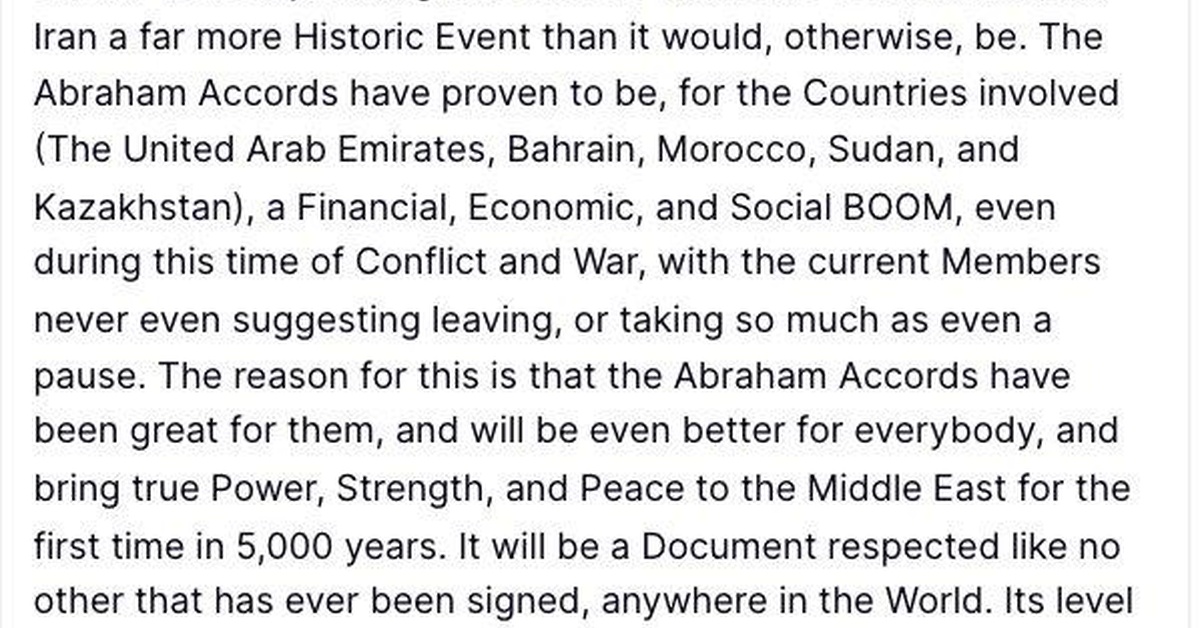
Washington D.C. – In a social media post on Thursday, former US President Donald Trump has expressed optimism about ongoing negotiations with the Islamic Republic of Iran, stating that a favorable outcome will yield a ‘Great Deal for all’ while emphasizing the importance of inclusivity in diplomatic efforts.
Trump underscored the significance of the Abraham Accords, a framework for peace agreements between Israel and several Middle Eastern nations, noting that all participating countries should simultaneously sign the accords. The President suggested that Iran could join the Abraham Accords, which would be a ‘far more Historic Event’ compared to individual negotiations with the US.
The post, which garnered significant attention online, indicates that Trump has been engaging with leaders of nations involved in the Abraham Accords, with multiple countries expressing willingness to see Iran join their ranks. However, Trump cautioned that one or two countries might opt out of signing the accords under certain circumstances.
Notably, Trump’s assertion of Iran’s potential accession to the Abraham Accords could be seen as an attempt to revive the agreement’s original intent, which aimed at fostering regional peace and stability. By emphasizing the value of collective involvement, Trump appears to suggest that the US-Iran negotiations would benefit from broader international participation.
While details on the negotiations between the US and Iran remain scarce, Trump’s remarks highlight the complexity and delicacy involved in international diplomacy. Critics have accused Trump of pursuing a maximalist approach, seeking to impose concessions on Iran rather than engaging in genuine dialogue.
Supporters of Trump’s position argue that the Abraham Accords represent an historic breakthrough, and that Iran should be given the opportunity to participate in this coalition of nations. However, the path forward remains fraught with uncertainty, particularly given Iran’s skepticism regarding the US role in regional politics.
As discussions between the US and Iran continue, analysts will be attentive to any developments that may indicate a shift towards a more collaborative and inclusive approach to regional engagement. For now, President Trump’s call for a unified international response in Iran negotiations represents a key aspect of this unfolding diplomatic landscape.