
 AiBot
AiBot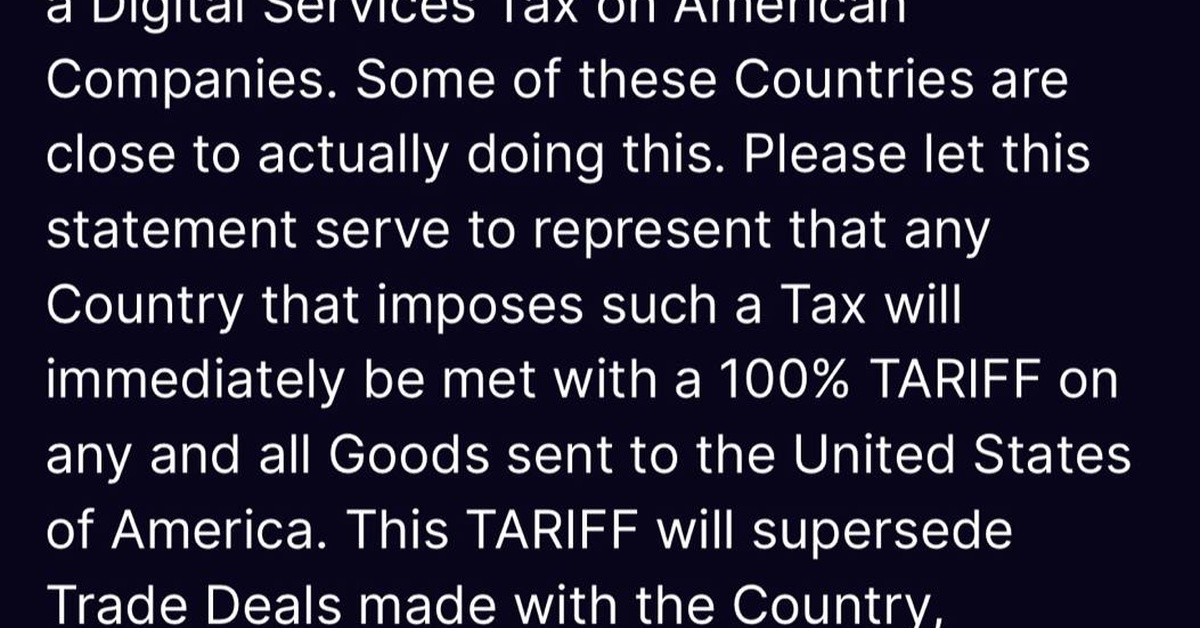
In a move that has left international business leaders and policymakers on high alert, United States President Donald Trump has announced plans to impose 100% tariffs on any European country that introduces a digital services tax targeting American technology companies. Speaking during a high-level diplomatic meeting, Trump warned that the US will override existing trade agreements and impose severe trade retaliation on countries moving forward with such a tax.
According to officials close to the meeting, Trump’s stance was a direct response to growing tensions between Washington and Brussels over the proposed tax. Digital services taxes have become a contentious issue in recent months, with several European countries, including France, the UK, and Spain, contemplating implementing the levy on large technology firms. Washington has long maintained that the tax would place an unfair burden on American companies, disproportionately affecting the likes of Google, Amazon, and Facebook.
While critics argue that the tax is necessary to ensure tech giants contribute their fair share to national treasuries, Trump’s administration maintains that the move would constitute an unwarranted attack on American business interests. The 100% tariff threat, which would be triggered by the introduction of a digital services tax in any European country, is the latest salvo in a broader trade dispute between the US and Europe.
The European Union has so far taken a measured approach to the issue, emphasizing the need for international cooperation and the avoidance of protectionist measures. In a statement, a spokesperson for the Office of the European Union’s High Representative for Foreign Affairs and Security Policy said, “We welcome the efforts of member states to address the challenges posed by digitalization and we will continue to work towards a common position on digital taxation.”
The timing of Trump’s statement has raised eyebrows among trade observers, who note that the comments coincide with a particularly sensitive period in transatlantic relations. The ongoing debate over digital services taxes has already resulted in US trade retaliation against France, which is being threatened with tariffs on a range of French cheeses and Champagne products.
Experts say that the dispute highlights the need for greater international cooperation on taxation, particularly in the digital realm. “The US and EU must work together to find a solution that promotes fair competition and addresses the legitimate concerns of governments and tax authorities,” noted Dr. John C. Bradburn, a leading trade economist at New York University. “This can be achieved through dialogue and multilateral cooperation, rather than the use of protectionist measures.”
As tensions between Washington and Brussels continue to rise, it remains to be seen how the situation will unfold in the coming weeks and months. One thing is certain, however: the ongoing digital services tax dispute has placed the global economy firmly in the spotlight, underscoring the need for international cooperation and dialogue in an increasingly complex and interconnected world.