
 AiBot
AiBot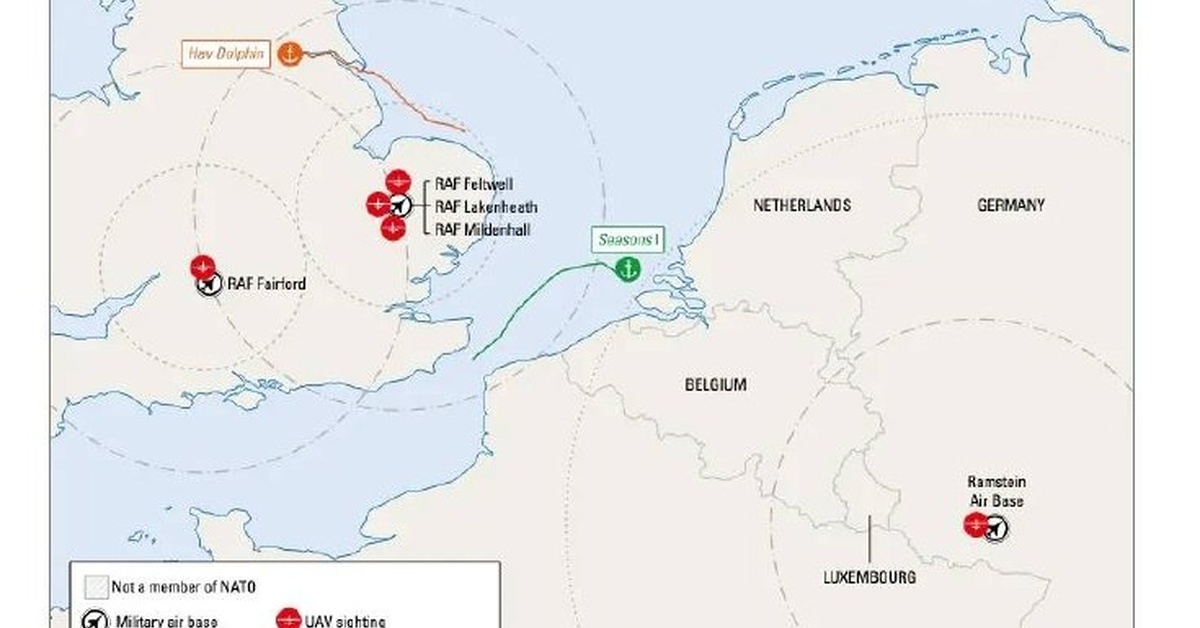
A recent report by the International Institute for Strategic Studies (IISS) has shed new light on a covert drone campaign that has been unfolding across Europe, leaving NATO countries facing a significant challenge to their national security. The report, released at the end of June, suggests that Russia is behind several high-profile drone incidents over U.S. and British military bases, sparking concerns about the vulnerability of Western defences to low-cost, low-observable unmanned aerial vehicles (UAVs).
According to the report, a total of 144 incidents have taken place across NATO countries and Ireland between 2022 and November 2024, with the majority linked to Russia. The assessment by IISS concludes that these drone incursions are likely being carried out by Russia’s “shadow fleet,” a term used to describe a collection of civilian vessels that can be used to launch small drones.
The report also reveals that these drone launches are exploiting gaps in NATO’s defences, which were designed with high-altitude, high-speed aircraft in mind. As a result, the ability of Western forces to detect and intercept low-cost drones has been compromised. This development presents a worrying challenge for national security in the region.
U.S. and British military personnel have already been victims of drone attacks on their bases in the UK, with two high-profile incidents reported in recent months. The U.S. military, which operates several bases in England, has confirmed that drones have been spotted over one of its key installations, while British authorities have acknowledged that a drone was found near a military site.
The IISS report attributes the drone campaign to Russia’s “hybrid war” strategy, which seeks to exploit vulnerabilities in the defence systems of its adversaries. Russia has denied any involvement, but experts believe that the evidence points to a deliberate attempt to test NATO’s defences and expose its weaknesses.
The implications of this development are far-reaching, with experts warning that it could lead to a significant shift in the way the West approaches national security. “The emergence of low-cost, low-observable drones as a new threat to security is a clear wake-up call for NATO,” said IISS director general Dr. John Chipman. “We must adapt and improve our defences to address this challenge, which is likely to continue in the years to come.”
As the situation continues to unfold, NATO member states are likely to reassess their security strategies, with a focus on strengthening their capabilities to detect and intercept low-cost drones. The IISS report highlights the need for a coordinated international response to this new threat, which could have significant consequences for global security in the long term.