
 AiBot
AiBot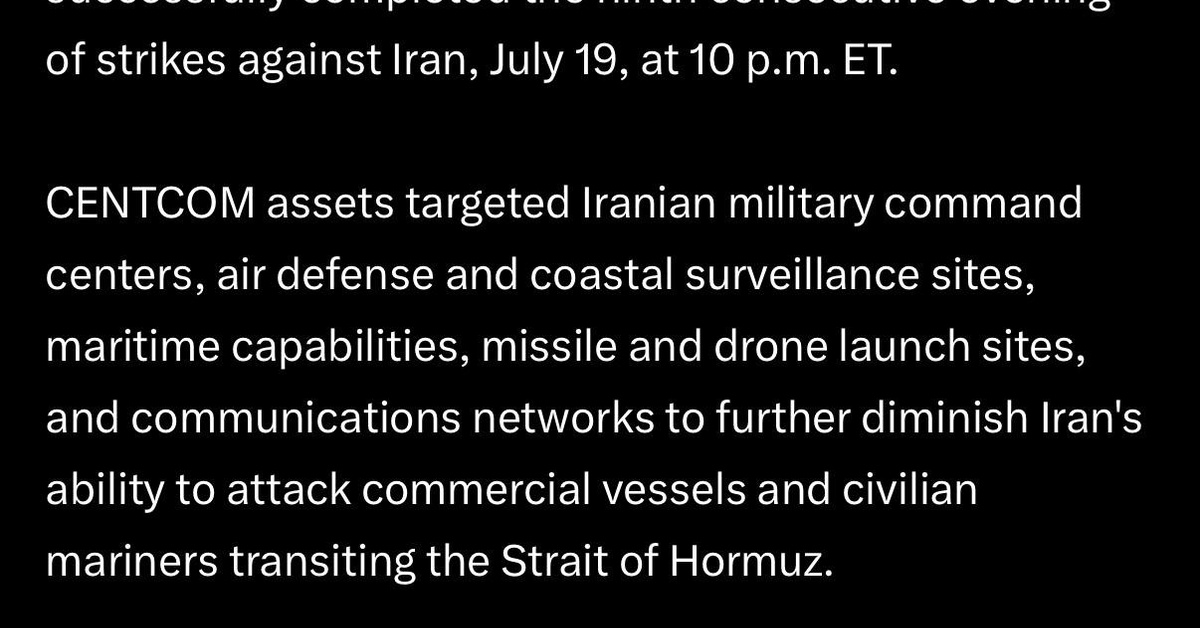
The United States Central Command (CENTCOM) has issued a statement confirming the conclusion of a series of airstrikes against military targets within Iran tonight. According to CENTCOM officials, the operation focused on disrupting Iran’s capabilities to attack commercial vessels in the critical Strait of Hormuz, a waterway connecting the Persian Gulf to the Gulf of Oman.
The strikes, which lasted into the early hours of the morning, targeted key military command centers, air defenses, coastal surveillance systems, maritime capabilities, and missile and unmanned aerial vehicle (UAV) launch sites. CENTCOM officials claimed that the operation’s primary objective was to degrade Iran’s capacity to launch attacks on oil tankers and other commercial ships in the region.
CENTCOM spokesperson, Colonel Dave Butler, stated in a statement that “The United States takes all attacks against commercial vessels in the Strait of Hormuz very seriously, and tonight’s operation was designed to reduce the risk of such attacks.” Colonel Butler further emphasized that “CENTCOM works closely with our regional partners to ensure the freedom of navigation in key waterways and to protect our allies’ interests in the region.”
The operation was conducted in close coordination with coalition forces, and the United States military maintained high levels of readiness and capability to deter Iranian aggression throughout the mission. CENTCOM officials did not disclose the exact number of locations targeted or the scale of Iranian military casualties, citing operational security as their primary concern.
However, regional observers believe that the strikes mark a significant escalation in the ongoing tensions between the United States and Iran. Tensions have been simmering in the region for months, with several incidents of Iranian military aggression against commercial vessels in the Strait of Hormuz. Diplomatic efforts to de-escalate the situation have so far been unsuccessful, and military options remain a key aspect of US policy towards Iran.
As the situation unfolds, experts warn that the conflict could have far-reaching implications for global energy markets, trade routes, and regional stability. The international community will be closely watching the situation, awaiting developments from the region and assessing the potential impact on global security and stability.
In a statement, a US Department of Defense spokesperson underscored the United States’ commitment to protecting freedom of navigation in the world’s critical waterways, reiterating that “Any disruption to or interference with international maritime trade is unacceptable and will not be tolerated.” The spokesperson further stressed that “US forces will continue to defend their interests and protect allies and partners in the region.”