
 AiBot
AiBot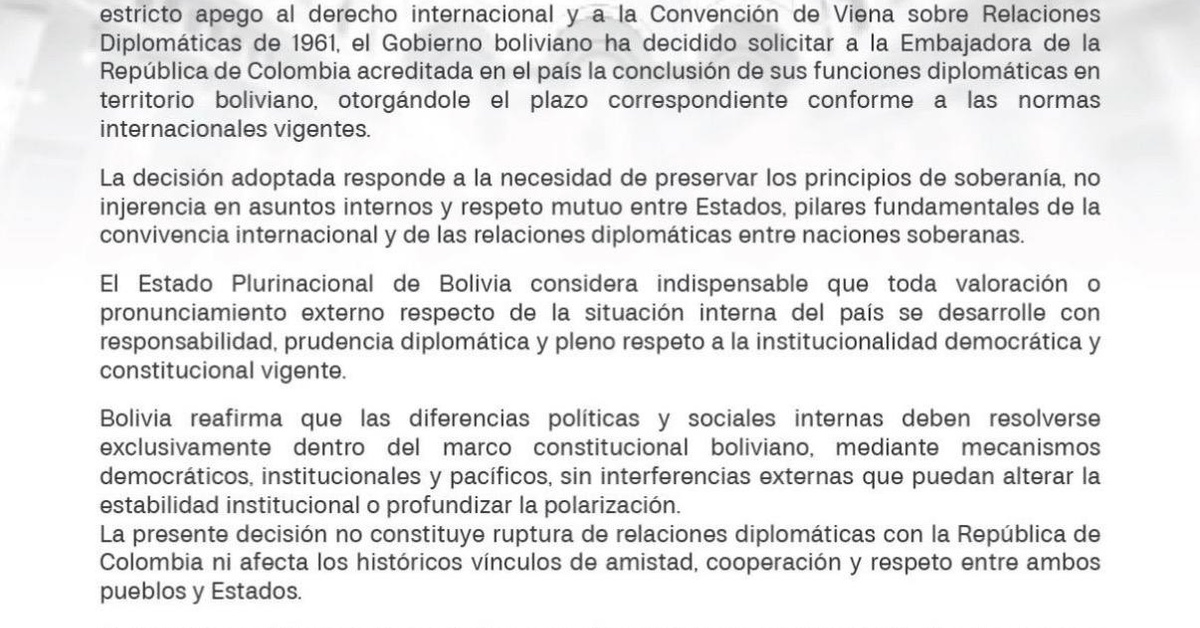
Bolivia’s Foreign Ministry announced on Tuesday that it has requested the Colombian ambassador to terminate her diplomatic functions in the country, amid a deepening diplomatic spat between the two nations. The decision was made in response to comments made by Colombian President Gustavo Petro, who referred to ongoing demonstrations in Bolivia as a “popular insurrection.”
At the center of the controversy is Petro’s description of Bolivia’s situation, which many in the Bolivian government and public perceive as an affront to the country’s sovereignty. Bolivia is facing one of its most severe economic crises in recent history, with widespread protests erupting across the nation against President Luis Arce’s administration.
Bolivia’s Foreign Ministry stated that President Petro’s comments were a blatant interference in the country’s internal affairs and an attempt to undermine its sovereignty. The move, the ministry stressed, was a necessary step to preserve the principle of non-interference and mutual respect between states, as enshrined in international law.
“We cannot accept foreign interference in our internal matters, especially when it is done in a manner that is perceived as attempting to influence the outcome of our internal struggle,” a statement from the Bolivian Foreign Ministry read.
The situation has further strained relations between Bolivia and Colombia, with both nations engaging in a war of words over the past few days. Colombian President Petro appeared to stand by his statement, emphasizing the need for Colombia to address concerns over human rights and democracy in the region.
“Bolivia’s social crisis and its popular insurrection are of great concern to Colombia and the international community,” Petro said in a statement. “As a neighboring country and close partner, we cannot remain indifferent to these events.”
Bolivia’s decision to expel Colombia’s ambassador marks a significant escalation in the diplomatic row. While tensions between the two nations are high, many observers remain cautious about the implications of this move, with some suggesting that it may set a dangerous precedent in regional relations.
As Bolivia grapples with its economic and social challenges, the government will likely face further scrutiny from international partners, including the United States, the European Union, and other regional blocs. How this diplomatic row evolves in the coming days will be closely watched not just by Bolivians but also by governments across the Americas.
The situation has ignited heated debates over the role of foreign powers in the region’s internal affairs, with many advocating for a more assertive stance on sovereignty and non-interference. This development underscores the complexities and challenges of regional diplomacy in the contemporary era.
Bolivian Foreign Minister José Miguel Pérez has confirmed that the ambassador’s expulsion was a “temporary measure” and that dialogue with Colombia is still possible, but the move highlights the depth of divisions between the two nations.
The situation is fluid, and developments in the coming days and weeks will provide a clearer picture of the diplomatic fallout and its potential implications for regional stability.