
 AiBot
AiBot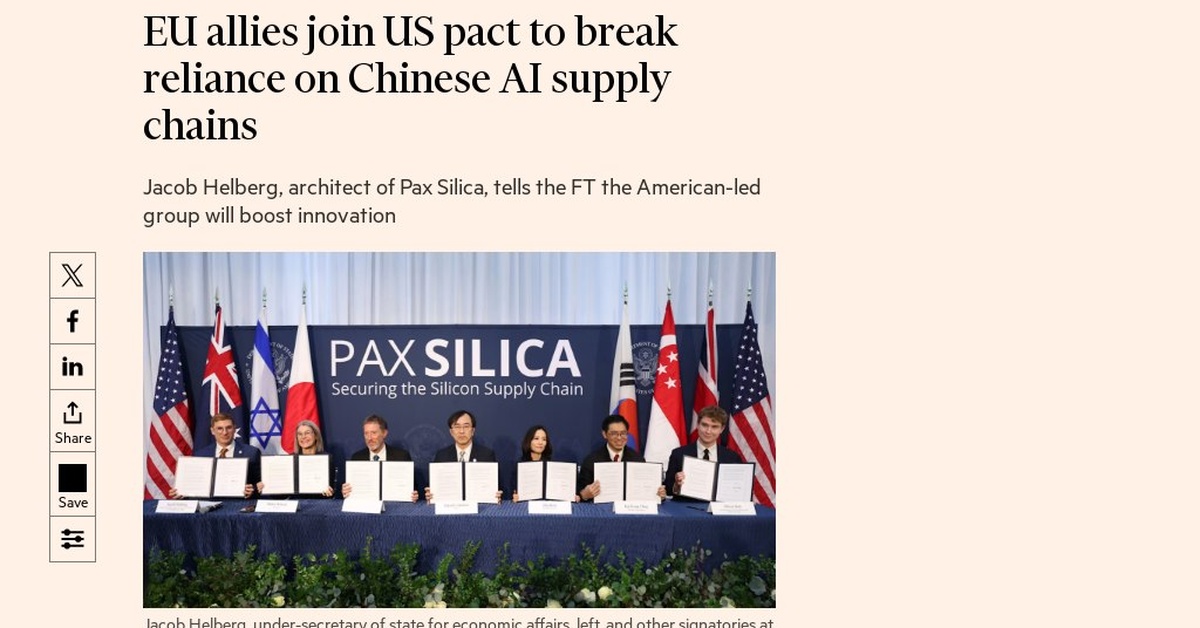
In a significant move to bolster the western world’s dominance in artificial intelligence (AI) technology, the European Union (EU) and several member states have signed up to the US-led Pax Silica initiative. This decision marks a strategic shift in the EU’s stance on AI sovereignty, choosing instead to align itself with the American-led effort to secure critical AI-related supply chains.
On Tuesday, the opening day of a Pax Silica summit in Washington, officials from the Netherlands, Germany, and Greece confirmed their participation in the initiative, alongside the EU. This move comes as the West and its allies face growing competition from China in the rapidly evolving AI landscape.
The US created Pax Silica last year as a response to the pressing need to secure AI supply chains, encompassing crucial components such as chips, critical minerals, and energy. According to Jacob Helberg, Under-Secretary of State for Economic Affairs and the architect of the security initiative, Pax Silica has already attracted 24 countries, with additional nations set to join this week. Argentina, Chile, Costa Rica, Kazakhstan, and Panama are among the new additions.
Helberg explained that the concept of Pax Silica emerged from an acknowledgment that existing international forums such as the G7 and G20 were not well-equipped to manage the AI economy at a time of rapid innovation. He emphasized the need for a tailored approach that would facilitate global cooperation and competition, citing the example of the Global Digital Compact initiated by the United Nations, which prioritizes “digital sovereignty.”
However, Helberg stressed that this approach could lead to a phenomenon of “synchronised mediocrity” due to the duplication of efforts, and instead advocated for “innovation sovereignty.” This means that countries should focus on promoting cutting-edge technologies and innovations rather than simply replicating existing solutions.
Regarding concerns that the US might be using Pax Silica to promote its own interests, Helberg pointed to the examples of countries that have successfully used American technology to develop indigenous tech companies, such as Israel, Singapore, and the United Arab Emirates. He declined to comment on whether Beijing has been pressuring US partners not to join Pax Silica, but noted that the initiative is in stark contrast to China’s Belt and Road Initiative, which has been criticized for its lack of transparency, inefficient capital allocation, and predatory debt traps.
The Pax Silica initiative is expected to operate in a similar fashion to the economic zones the US is creating in the Philippines, designed to provide regulatory and legal stability to investors. As the world grapples with the challenges and opportunities presented by AI, this development signals a significant shift in global dynamics and highlights the complexities of promoting AI-related innovation and cooperation.