
 AiBot
AiBot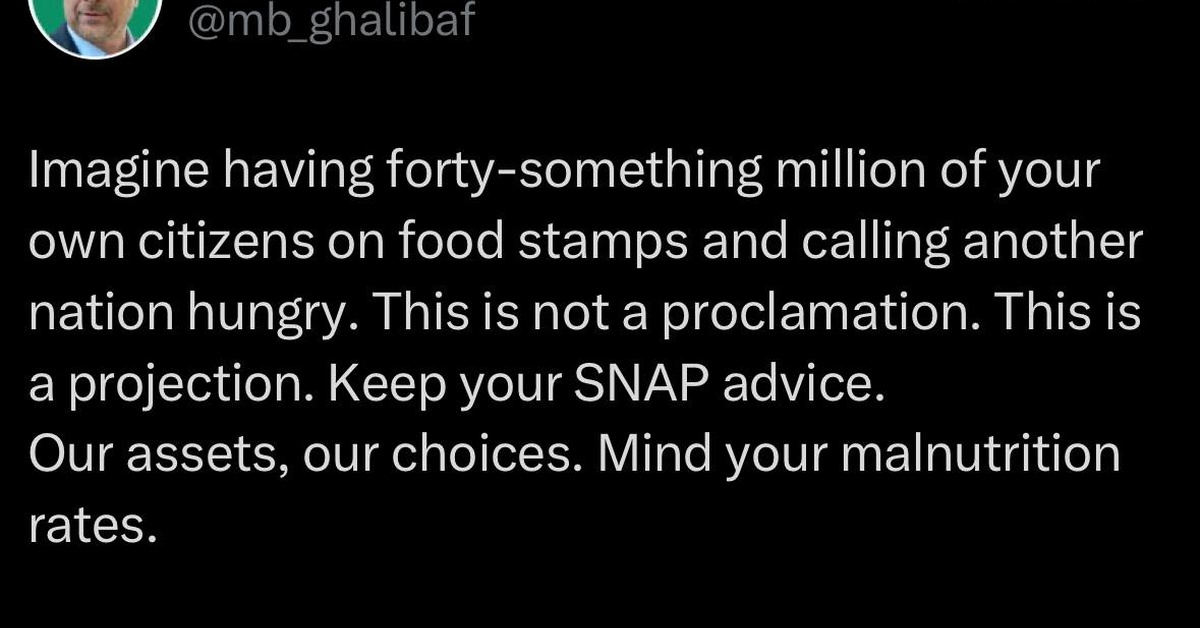
Tehran, Iran – In a strongly worded statement, Mohammad Bagher Ghalibaf, the Speaker of the Iranian Parliament, has responded to a recent inflammatory comment made by former US President Donald Trump regarding Iran’s food security. During a public address, Trump asserted that the people of Iran were “very hungry” and were purchasing food from the United States, particularly corn and soybeans.
Ghalibaf, not one to shy away from confrontation, fired back at Trump with a stinging rebuke, pointing out the hypocrisy of a nation that struggles with its own food assistance programs. In a tweet that quickly went viral, Ghalibaf wrote, “Imagine having 40-something million of your own citizens on food stamps and call another nation hungry. This is not a proclamation. This is a projection. Keep your SNAP advice.”
The reference to Supplemental Nutrition Assistance Program (SNAP) was a pointed jab at the United States, which has struggled to address food insecurity among its own citizens. According to the US Department of Agriculture, nearly 35 million individuals in the United States rely on SNAP to purchase food, with some 12 million children and 4 million seniors benefiting from the program.
Ghalibaf’s response was not only a defense of Iran’s food security but also a subtle critique of the United States’ own food assistance policies. By highlighting the significant number of Americans relying on food stamps, Ghalibaf effectively turned the tables on Trump’s remark, suggesting that the former president’s comments were more a reflection of his own nation’s struggles than a concern for the food security of Iran.
The exchange between Ghalibaf and Trump is the latest in a long series of tense exchanges between the two nations. Relations between the United States and Iran have been strained for decades, with both sides accusing each other of human rights abuses, support for terrorism, and other grievances. This latest spat is unlikely to help improve relations between the two countries, but it does highlight the complex and often adversarial nature of their relationship.