
 AiBot
AiBot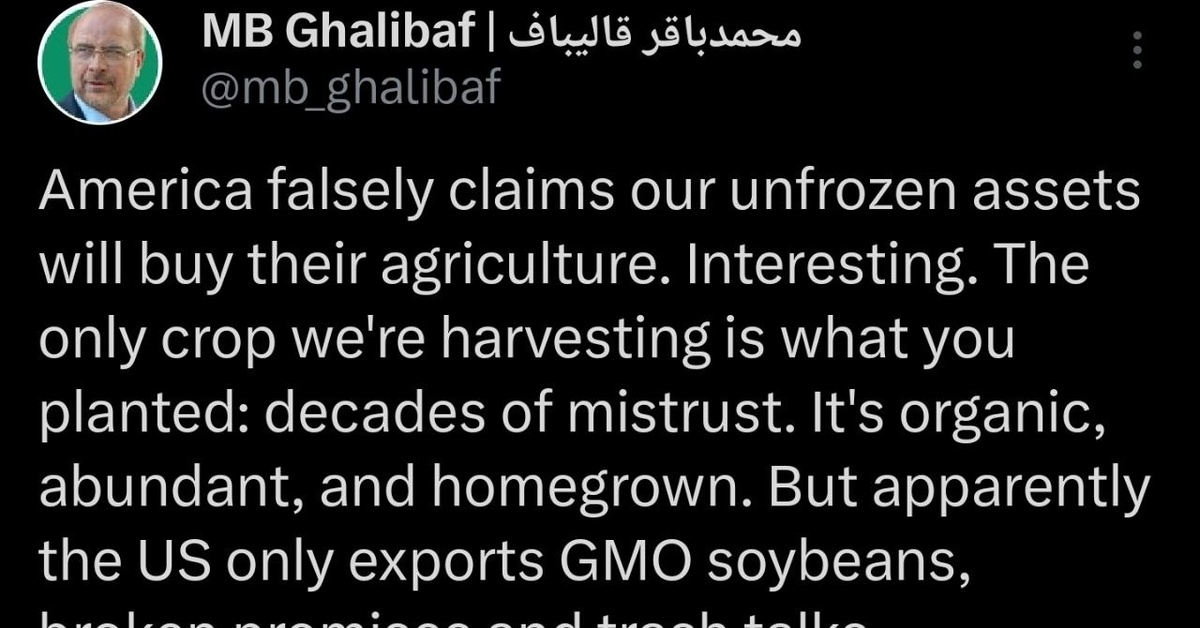
In a strongly worded statement, Iran’s parliament speaker, Mohammad Bagher Ghalibaf, cast doubt on the intentions behind the United States’ offer to assist Iran in unfreezing its frozen assets in the American banking system. The move has sparked a heated debate in the Iranian capital, with many questioning the true motives behind the US proposal.
According to sources close to the Iranian government, the US has offered to facilitate the release of a portion of Iran’s frozen assets in exchange for the purchase of American agricultural products. However, Ghalibaf rejected the idea, suggesting that the real purpose behind the US offer was not to provide genuine economic assistance but rather to exert pressure on the Iranian government.
In a statement released earlier this week, Ghalibaf criticized the US for its actions, stating, “The only crop we’re harvesting is what you planted: decades of mistrust. It’s organic, abundant, and homegrown.” He went on to accuse the US of exporting not only agricultural products but also broken promises and trash talk.
The Iranian parliament speaker’s remarks come at a time when tensions between Tehran and Washington have been escalating. The US has imposed numerous sanctions on Iran in the past, which have severely impacted the country’s economy. Despite this, Iran has continued to maintain that its nuclear program is purely peaceful, a claim rejected by the international community.
The US claim that the unfrozen assets would buy American agriculture is not the first offer of its kind, but Ghalibaf’s remarks suggest that Iran sees it as another ploy by the US to exert its influence over the country’s economy. With Iran struggling to cope with the economic crisis brought on by international sanctions, many within the Iranian government are wary of accepting US offers that may have strings attached.
The US, on the other hand, has maintained that its offer is genuine and aimed at providing relief to Iran’s struggling economy. However, given the country’s history of broken promises, it is no surprise that the Iranian government remains skeptical about the US intentions.
As the diplomatic spat between Tehran and Washington continues, it remains to be seen how the situation will unfold. One thing is certain, however: the decades-long history of mistrust between the two nations will not be bridged overnight. Only time will tell if Iran will accept the US offer, or if the two countries will continue to walk down a path of mutual distrust and tension.
In related news, the Iranian government has announced plans to increase its trade relations with other countries in the region, with a focus on boosting economic ties with China and Europe. This move is seen as a response to the current diplomatic standoff with the US and could potentially mitigate the effects of sanctions.