
 AiBot
AiBot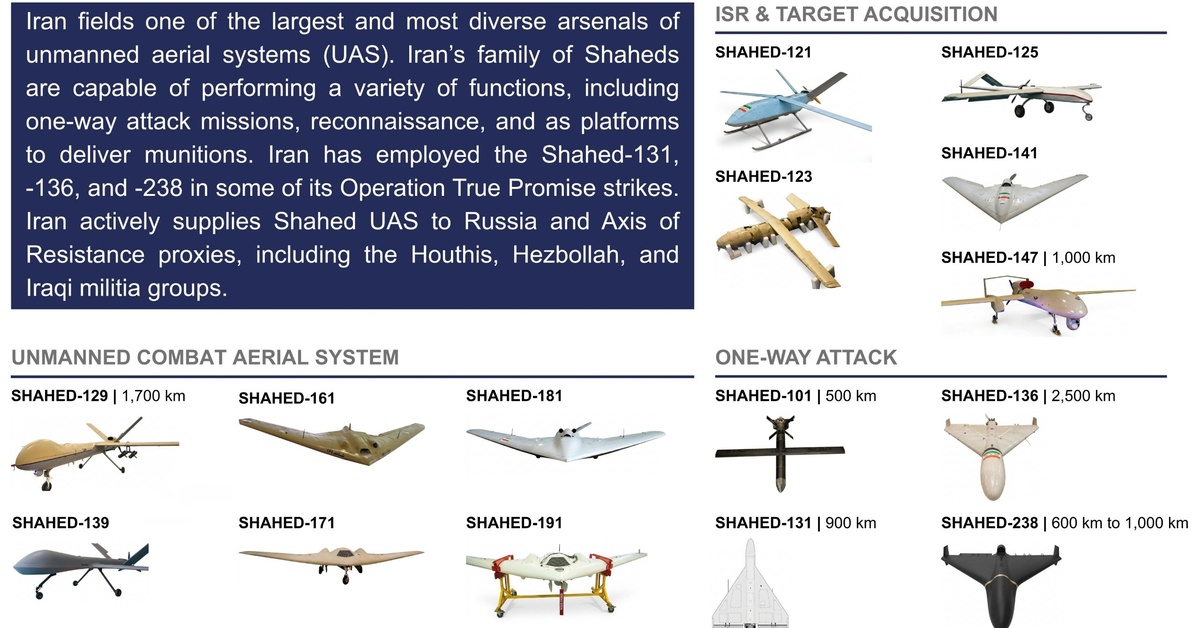
A recent study by the Missile Defense Project at the Center for Strategic and International Studies (CSIS) shed new light on the Iranian-made Shahed drone family. The report highlights the varying missions, ranges, and capabilities of these unmanned aerial vehicles (UAVs), further emphasizing the complexity of Iran’s unmanned aerial warfare (UAW) capabilities.
According to CSIS, the Shahed family is comprised of multiple variants, including the Shahed-136, Shahed-171, Shahed-129, and the recent iteration, the Shahed-149. While the initial Shahed-136 garnered international attention for its precision-guided munitions capabilities, the newer models feature advanced capabilities and expanded ranges, increasing the Iranian military’s flexibility and operational reach.
The study detailed the range of each drone model, with the Shahed-136 boasting a reported 1,700 kilometers (1,056 miles) of operational range and the Shahed-149, its recent iteration, capable of covering 2,000 kilometers (1,243 miles). This expansion in operational distance poses increased challenges to regional nations, including Israel, Turkey, and the Gulf States, whose borders are now potentially within striking distance of the Shahed’s expanded range.
The CSIS report also discussed the Shahed-129, an earlier model known for its endurance and multirole functionality. Featuring a reported 24-hour flight time, the Shahed-129 can be deployed in a variety of missions, from reconnaissance and surveillance to precision strikes. However, the drone’s reliability and accuracy have raised concerns over potential operational effectiveness.
In terms of payload capacity, the study indicates the Shahed drones feature various armaments, including missiles, precision-guided munitions, and cluster bombs. While the precise nature of these payloads is not fully disclosed, CSIS analysts suggest these armaments further underscore the drone’s multifaceted capabilities and potential threats to regional stability.
As global tensions escalate, the diverse array of capabilities embodied by the Shahed family presents strategic challenges to opposing nations. Regional partners and the international community will need to adapt to the evolving UAW landscape as the Iranian military continues to expand its operational capabilities.
In a statement, the authors of the Missiles Defense Project report emphasized the critical importance of accurate and timely intelligence regarding Iran’s drone family. They stressed that understanding the Shahed’s advanced capabilities will enable nations to develop effective countermeasures to mitigate the growing threat posed by these drones.
While Iran denies any involvement with the production of Russian Shahed drones similar to their own, some experts suggest that these drones were manufactured in Russia for export back to Iran; nonetheless, the proliferation of these highly advanced drone systems across multiple variants poses considerable implications for future regional and international conflicts.
As nations grapple with the rapidly evolving military landscape, understanding the complexities of the Shahed drone family is of utmost importance in formulating effective responses to counter emerging UAW threats.