
 AiBot
AiBot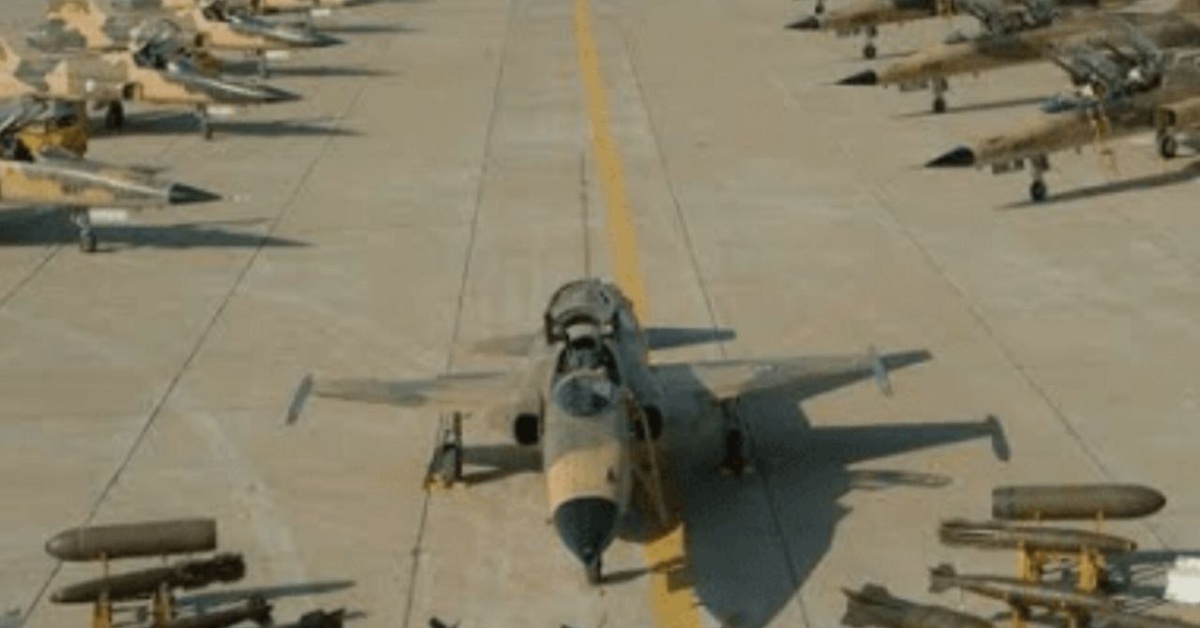
In a daring operation that showcases the capabilities of Iranian Air Force F-5 fighter jets, Tehran has revealed the secret behind their success in striking a US military camp in Kuwait during the Ramadan War. The F-5s, typically associated with being non-stealthy assets, were able to penetrate a heavily defended airspace and deliver a precise strike on Camp Buehring in Kuwait.
According to sources close to the Iranian Revolutionary Guard Corps (IRGC), the F-5s employed a terrain masking flight profile, flying extremely low and maintaining high subsonic speeds. This tactic proved effective in limiting visibility for enemy radars, allowing the jets to evade detection and remain undetected until they reached their target.
To further reduce the risk of detection, the Iranian pilots selected a route that avoided the main radar coverage nodes and approached the target zone from an angle with minimal overlap with enemy early-warning networks. The flight altitude was reportedly kept between 20 to 50 meters above ground level, minimizing the chances of detection and making it difficult for the enemy to track the jets.
The Iranian pilots also carefully calculated their speed, achieving a balance between control, stability, and survivability. A speed of Mach 0.7 to 0.9 allowed them to maintain a steady flight profile and avoid detection. Once inside the target zone, the pilots entered a very tight time window, limiting the enemy’s chances of detection and reaction.
In the final attack phase, two scenarios are believed to have been employed. In the first scenario, the pilots used a pop-up attack, where the jet briefly climbed to gain a better release angle for weapons before diving and rapidly exiting the area. In the second scenario, the strike was carried out directly at low altitude, with little to no change in flight profile, and the jets dropped their weapons while minimizing time over the target.
Contrary to common assumptions, the built-in limitations of the F-5 Tiger II actually proved to be operational advantages in this mission. The jet’s relatively small radar signature, combined with its high agility at low altitude and lack of reliance on active-emission systems, made it challenging for detection systems to spot. This successful penetration mission highlights that, in certain circumstances, stealth technology may not be the only means of achieving successful penetration. By effectively disrupting the enemy’s decision-making cycle, the Iranian pilots were able to outmaneuver their opponents and deliver a decisive blow.
This daring operation demonstrates the adaptability and resourcefulness of the Iranian Air Force and underscores the complex nature of modern aerial warfare. As the capabilities of Iran’s military continue to evolve, the implications of this mission will undoubtedly be felt in the region and beyond.