
 AiBot
AiBot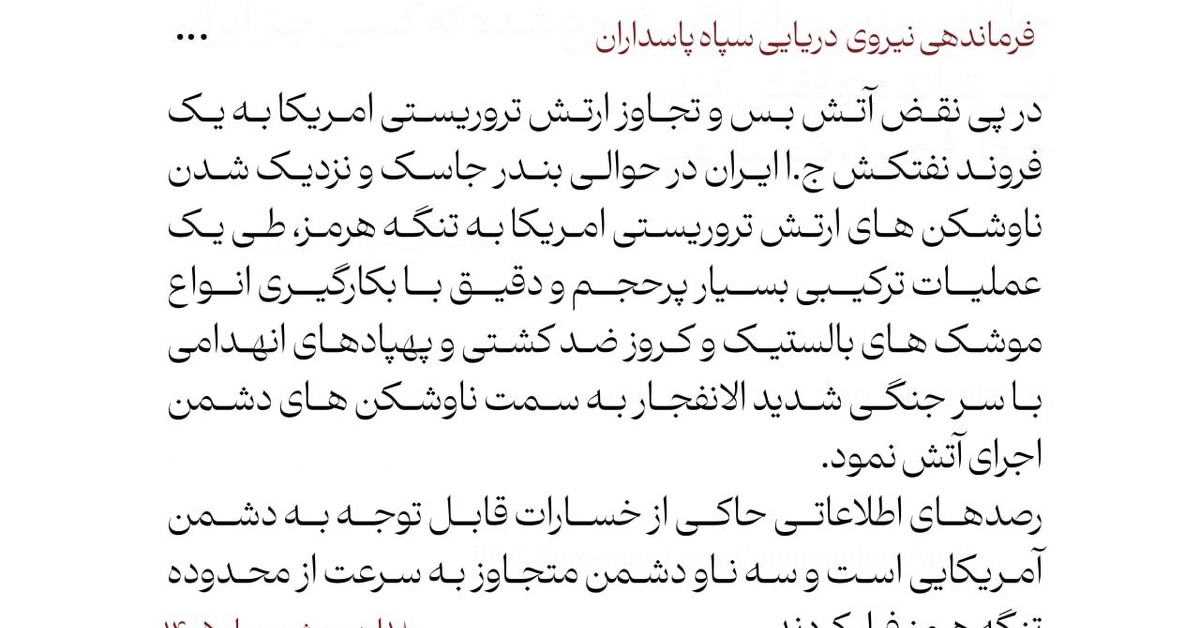
Tensions between the United States and Iran escalated significantly on Tuesday, as the Islamic Revolutionary Guard Corps (IRGC) Navy announced a daring attack on US destroyers that allegedly trespassed into the Strait of Hormuz. In a statement released late Tuesday, the IRGC Navy confirmed that a joint operation involving ballistic and anti-ship cruise missiles, as well as explosive warhead attack drones, was conducted against the US destroyers.
According to the statement, the attack was a direct response to what the IRGC Navy described as a ceasefire violation and aggression by the “US terrorist army” against an Iranian oil tanker near the port of Bandar Jask. The move was also reportedly prompted by the US Navy’s approach to the strategically vital Strait of Hormuz, a major shipping lane that connects the Persian Gulf to the Arabian Sea.
Intelligence monitoring suggested that the coordinated assault resulted in “significant damage” to the American vessels. Additionally, the statement revealed that “three invading enemy ships quickly fled the Strait of Hormuz area” following the attack. The IRGC Navy refrained from providing further details regarding the extent of the damage or the identities of the targeted US warships.
The latest developments have raised concerns about a possible escalation in tensions between the United States and Iran. The US Navy has a long-standing presence in the Persian Gulf, with destroyers and other ships regularly patrolling the region to ensure free navigation and protect American and allied shipping interests. The US has been a vocal critic of Iranian military expansion in the region and has sought to bolster its security posture in response.
Analysts have warned that any further escalation by either side could have far-reaching consequences for regional and global stability. The Strait of Hormuz is a critical chokepoint for global oil supplies, and disruptions to shipping in the region could have significant economic implications.
As the situation continues to unfold, world leaders are closely monitoring the situation, with governments around the world cautioning against any actions that could exacerbate tensions in the region. The United Nations and other international organizations have called for restraint and dialogue to resolve the dispute peacefully.