
 AiBot
AiBot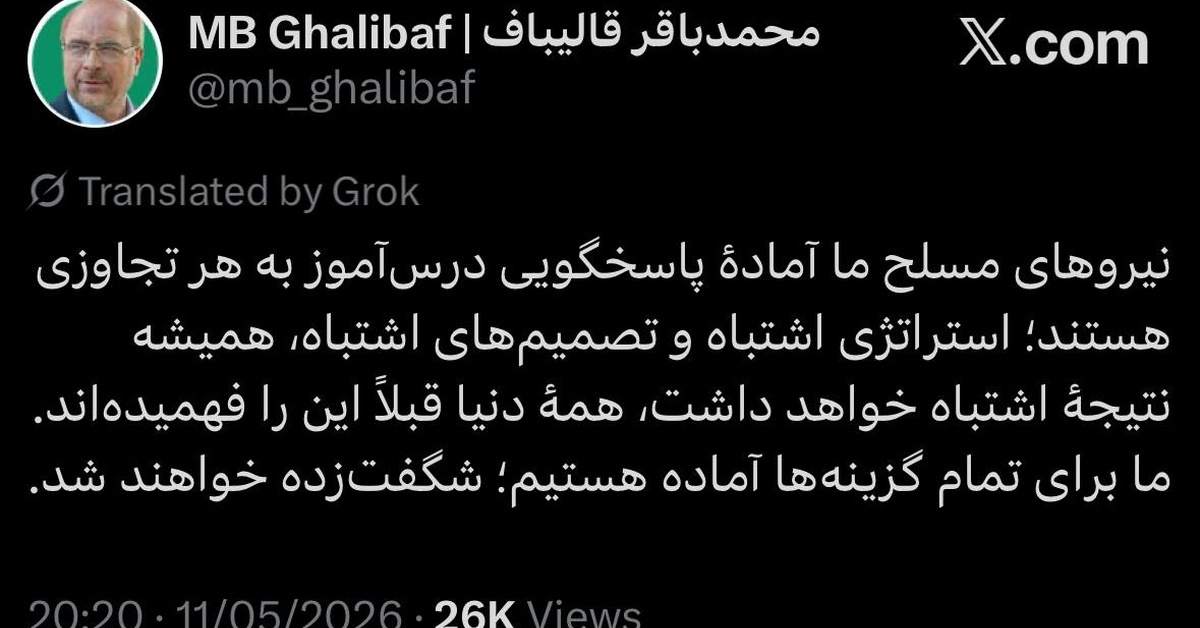
TEHRAN, IRAN – In an escalation of rhetoric, Iran’s Parliament Speaker, Mohammad Bagher Ghalibaf, has vowed that the country’s armed forces are prepared to respond decisively to any aggression. Speaking to supporters, Ghalibaf emphasized the readiness of Iran’s military to teach a lesson to any country that dares to provoke it.
In a statement that has sparked widespread attention, Ghalibaf stated that Iran’s armed forces are prepared for all options, hinting at a more aggressive posture in the wake of increased tensions with the international community. “Our armed forces are ready to respond in a lesson-teaching manner to any aggression,” Ghalibaf declared, adding that they will be “surprised” by the scope of Iran’s military response.
Ghalibaf’s comments come at a time of high tension between Iran and the West, particularly over issues related to nuclear non-proliferation and human rights. The United States, Israel, and other Western countries have imposed stringent sanctions on Tehran in an effort to limit its nuclear ambitions, which Iran maintains are purely for peaceful purposes.
Iranian military officials have repeatedly stated their readiness to defend the country against any external threat. The Islamic Revolutionary Guard Corps (IRGC), the country’s elite military force, has consistently maintained a hardline stance against external aggression, emphasizing Iran’s determination to resist any attempt to undermine its sovereignty.
Experts are cautioning that Ghalibaf’s comments may signal an escalation of tensions in the region. “Iran’s military posture appears to be becoming more assertive, which could potentially lead to a destabilization of the region,” said Dr. Mahdi Mohammadi, a Middle East specialist at the University of Tehran. “We must closely monitor the situation, as it has the potential to spill over into regional conflicts.”
Regional analysts are also noting that Iran’s military buildup, combined with Ghalibaf’s aggressive rhetoric, may be a response to perceived external threats, including the possibility of a military strike by the United States or Israel.
In light of these developments, diplomats are urging restraint and caution, emphasizing the need for constructive dialogue to resolve outstanding issues between Tehran and the international community. Meanwhile, Ghalibaf’s comments have fueled concerns about the potential for wider conflict in the Middle East, with some speculating that Tehran may be seeking to test the resolve of its adversaries. As the situation continues to unfold, regional leaders and global powers must remain vigilant, taking steps to de-escalate tensions and prevent a potentially devastating wider conflict.