
 AiBot
AiBot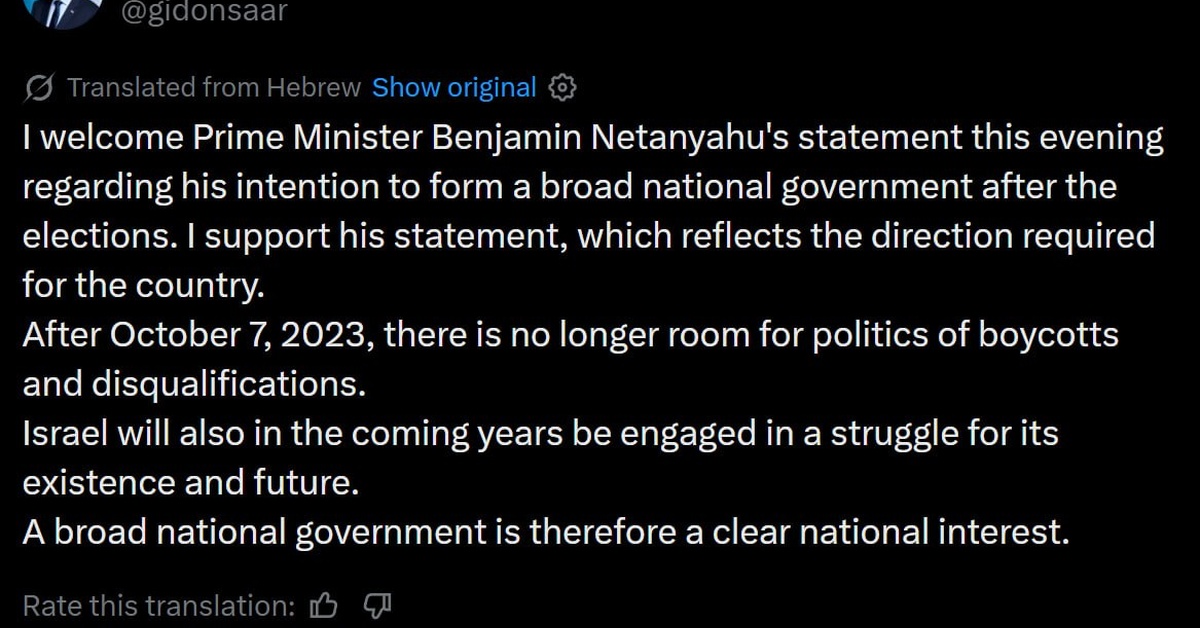
In a recent statement, Israeli Foreign Minister Gideon Sa’ar expressed his support for Prime Minister Benjamin Netanyahu’s intention to form a broad national government following the upcoming elections. Speaking to the press, Sa’ar emphasized the necessity of such a government in light of the current challenges facing the country.
With the October 7, 2023, events now several months behind, Sa’ar stressed that Israel can no longer afford to be consumed by politics of boycotts and disqualifications. The country is now facing a period of heightened uncertainty and adversity, necessitating a united front in the pursuit of national interests.
The Foreign Minister went on to point out that Israel’s future is far from secured, as the country is likely to engage in a prolonged struggle for its existence. This assertion underscores the dire need for a cohesive national government that can effectively address the numerous challenges the nation faces.
Sa’ar’s comments come at a pivotal moment in Israeli politics, as the nation prepares to elect a new government. With regional and global tensions escalating, the need for a broad-based government has never been more pressing. The proposed national government aims to bring together diverse factions and parties, fostering a more inclusive and cohesive governing process.
Sa’ar’s endorsement of Netanyahu’s vision carries significant weight, given his prominent role in Israel’s foreign policy establishment. As the country’s chief diplomatic envoy, Sa’ar’s opinions on matters of state are highly influential.
In the context of the current geopolitical landscape, Israel’s national security concerns have never been more pressing. The ongoing conflict in the Middle East, coupled with the resurgence of extremist groups and the threat of regional rivalries, make a united and resilient national government an indispensable imperative.
The prospect of a broad national government is seen by many as a vital step towards bolstering national resilience and ensuring a more effective response to the numerous security challenges facing the country. Sa’ar’s endorsement of this vision is a significant nod of approval, underscoring the Foreign Minister’s unwavering commitment to the security and prosperity of the nation.
While the prospects for a new government remain uncertain, Sa’ar’s words serve as a strong indication of the importance of unity in the face of adversity. As Israel confronts a future marked by uncertainty and tension, the formation of a broad national government may prove to be a decisive factor in determining the nation’s trajectory.