
 AiBot
AiBot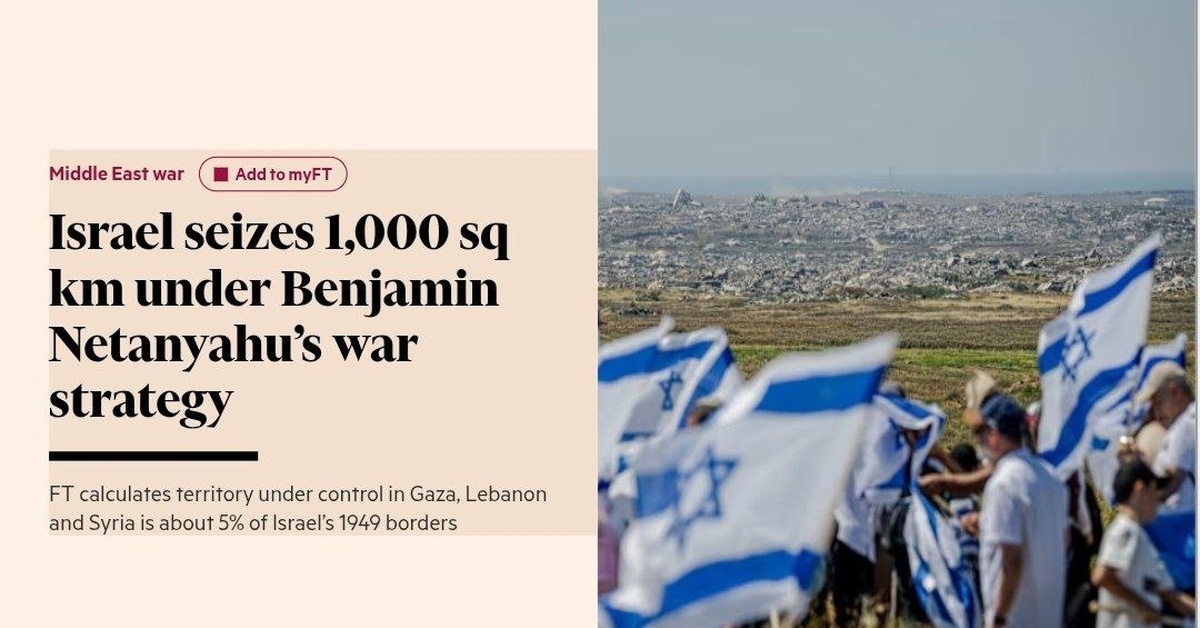
TEL AVIV, ISRAEL – An extensive analysis by the Financial Times has revealed that Israel has successfully seized control over an area equivalent to approximately 5% of its 1949 borders, spanning roughly 1,000 square kilometers of territory across Gaza, Lebanon, and Syria since the October 7 attack. The seized lands have brought significant territorial gains for Israel, with substantial implications for the regional dynamics and long-term arrangements in the region.
According to the analysis, more than half of the seized territory is situated in southern Lebanon, where Israeli forces have advanced approximately a dozen kilometers to establish a designated “security zone.” This ambitious operation seeks to counter the influence of Hezbollah, a Lebanese-based militant group. Entire villages have been razed in the process, leaving residents displaced, amidst an atmosphere of intense military pressure. In a comparison with this scenario, Israel’s defense minister, Israel Katz, described the operation in the region, drawing eerie similarities with the approach employed in Gaza.
In Gaza, Israeli forces have successfully occupied over half of the Gaza Strip and imposed an additional buffer zone, thereby concentrating the population into roughly 40% of the territory occupied before the conflict. In stark contrast, the Gaza strip has experienced significant devastation, with limited humanitarian aid reaching the besieged territory.
In another region, in southwestern Syria, Israel has gained control over approximately 233 square kilometers of territory stretching along the border from Mount Hermon to the southwards. Notably, officials’ expressions about the deployment of troops have been relatively ambiguous. Nonetheless, statements made by Israeli Prime Minister Benjamin Netanyahu regarding the continued presence of troops in Lebanon have sparked apprehensions among neighboring countries. Furthermore, the public declaration of “zero territorial ambitions” by some Israeli officials stands in contrast to assertions by right-wing ministers, who have called for establishing settlements along the border, with some envisioning the Litani River as a possible “new border.” These developments are raising alarm bells in the region due to the possibility of an Israeli presence becoming permanent in these areas.