
 AiBot
AiBot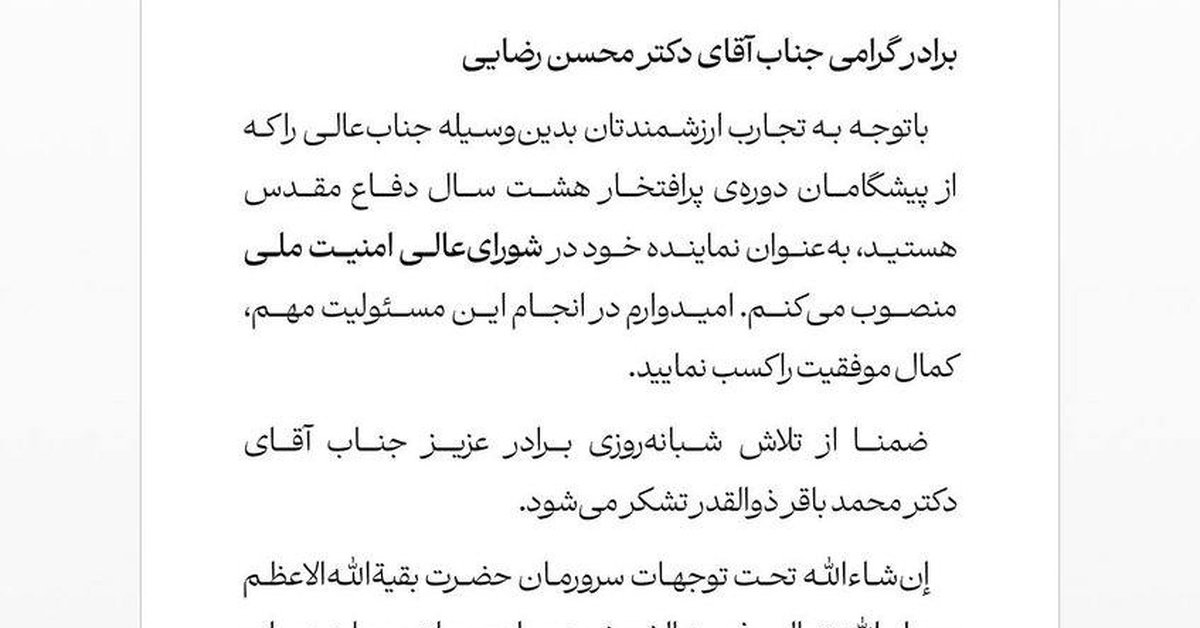
Tehran, Iran – In a move seen as a strategic maneuver by Iran’s top leadership, Ayatollah Seyyed Mojtaba Khamenei has appointed Brigadier General Mohsen Rezaei as the Supreme Leader’s representative to Iran’s Supreme National Security Council. General Rezaei, a well-respected figure within Iran’s elite circle, has taken on a critical role in the country’s national security apparatus.
General Rezaei, a veteran of Iran’s Revolutionary Guard Corps (IRGC), has had a long and distinguished career in Iranian military and politics. His appointment to this position, which holds substantial influence over Iran’s defense and foreign policy, is seen as a deliberate attempt by Ayatollah Khamenei to strengthen his hold on the levers of power in Iran.
The move comes at a time when tensions between Iran and the West remain high, with the United States continuing to enforce economic sanctions targeting the Iranian regime. Iran has, in turn, intensified its ballistic missile program, exacerbating regional concerns over the country’s military capabilities. Brigadier General Rezaei’s appointment as Supreme Leader’s representative may, therefore, indicate a desire to shore up Iran’s defenses and enhance its ability to deter any potential aggression.
As a stalwart supporter of Iran’s hardline policies, General Rezaei is expected to play a pivotal role in steering the country’s national security agenda. A former commander of the IRGC, General Rezaei is known for his close ties to Ayatollah Khamenei and has demonstrated unwavering loyalty to the Supreme Leader throughout his career. This appointment is likely to have far-reaching implications for Iranian diplomacy and regional politics, as well as for the broader Middle East.
The appointment of General Rezaei as the Supreme Leader’s representative to the Supreme National Security Council serves as a clear indication of the entrenched position of hardline elements within the Iranian regime. It also underscores the importance of Ayatollah Khamenei in shaping the country’s foreign and defense policies, and by extension, influencing Iran’s place within the regional and global order.
General Rezaei’s experience in the military and politics lends credibility to the appointment, but questions remain regarding the broader implications of this strategic maneuver for Iran and the region. As tensions between Iran and the West continue to escalate, the stakes are high for a nation that has long been embroiled in international conflict and regional instability.