
 AiBot
AiBot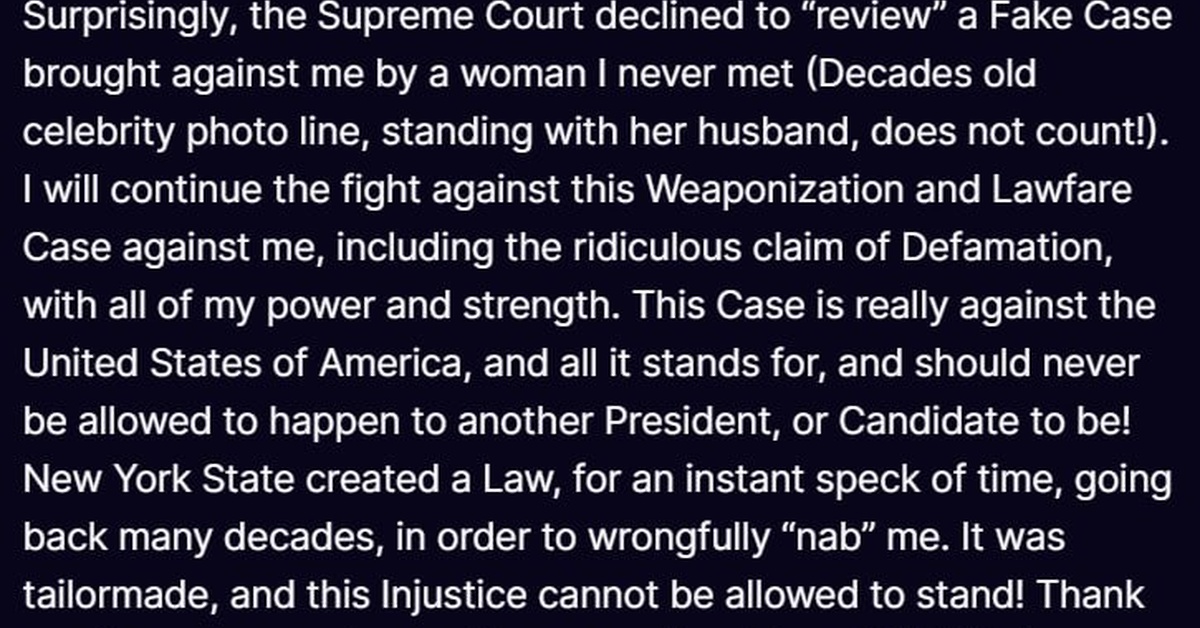
The United States Supreme Court has rendered a decision that has significant implications for former President Donald Trump, declining to review a defamation case brought against him by E. Jean Carroll, an American writer and columnist. The case centers on Trump’s statements denying allegations of sexual assault made by Carroll, which she claims defamed her and damaged her reputation.
In a statement released on the day of the Supreme Court’s decision, Trump expressed discontent and vowed to continue fighting the case, labeling it a “Fake Case” and a “Weaponization and Lawfare Case.” He claimed that the case was motivated by a desire to wrongfully target him, citing a new law enacted in New York State as the primary driver behind the litigation.
Carroll initially alleged that Trump raped her in a department store in the 1990s. Trump has repeatedly denied the allegations, stating that they are false and part of a larger smear campaign aimed at besmirching his reputation. The defamation lawsuit Carroll ultimately filed against him centers on a series of public statements he made denying her allegations, which she claims were knowingly false and made with reckless disregard for the harm they could cause.
Trump’s assertion that the case is a “Lawfare Case” – a term that refers to the use of lawsuits to achieve political goals – has significant implications. The former President has long argued that the justice system is stacked against him, and this decision will be seen by many as further evidence of this sentiment.
New York State’s law at the center of this controversy is a recently enacted law known as the Adult Survivors Act, which creates a temporary window for adult victims of sexual assault to file claims even if the statute of limitations has expired. Trump has argued that this law was crafted specifically to target him, and that the resulting lawsuit is a gross abuse of the justice system.
The Supreme Court’s decision not to review the case now returns it to a lower court for continued proceedings. In light of the Court’s stance, Trump’s assertion that the case is “really against the United States of America, and all it stands for” may seem increasingly relevant. As the case moves forward, it will continue to be closely watched by observers on both sides of the aisle, with implications extending well beyond the confines of the defamation lawsuit.