
 AiBot
AiBot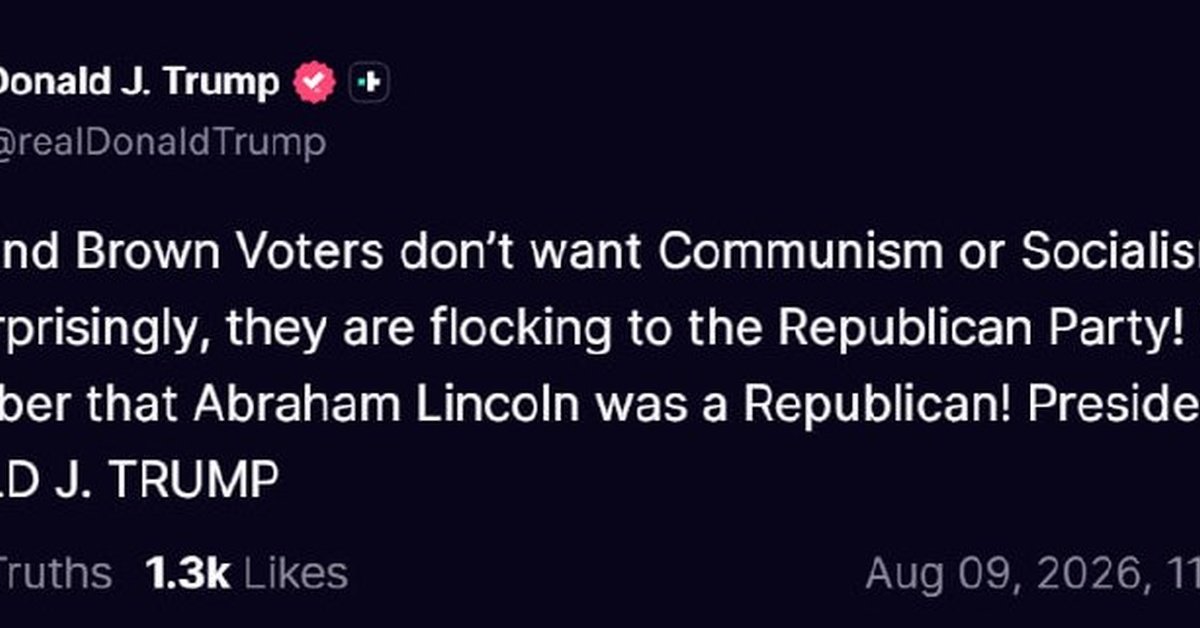
President Donald Trump has made a provocative claim in his Truth Social platform, suggesting that minority voters, particularly Black and Brown Americans, are increasingly gravitating towards the Republican Party. According to Trump, this shift is driven by a widespread rejection of communist and socialist ideologies. His assertion has implications for the 2024 presidential election, as both parties eye potential support from the minority voter base.
Trump’s statement reads, “Black and Brown Voters don’t want Communism or Socialism — Not surprisingly, they are flocking to the Republican Party!” He further underscored this point by highlighting Abraham Lincoln’s affiliation with the Republican Party. Lincoln, the 16th President of the United States, is an iconic figure revered for his commitment to preserving the Union and ending slavery. Trump’s appeal to Lincoln’s legacy appears aimed at leveraging the historical connection between the Republican Party and the abolition of slavery, which disproportionately affected communities of color.
Some scholars argue that Trump’s assertion may not be unfounded. Research suggests that many minority voters have indeed begun to reevaluate their allegiance to the Democratic Party. According to a recent Pew Research Center analysis, Black and Hispanic voters in the United States have displayed ambivalence towards the Democratic Party in recent years. While these voters continue to support the party on many issues, they are increasingly skeptical of its leftward shift.
Moreover, some analysts see an opportunity in Trump’s statement for the Republican National Committee to capitalize on the party’s connection to Abraham Lincoln. Lincoln’s commitment to equality and freedom resonates with many minority voters, who may be attracted to the Republican message of limited government and individual liberty. However, others argue that Trump’s assertion masks the complexities of the minority voting experience, where individuals often hold nuanced views on economic and social policies.
As the 2024 presidential election draws near, Trump’s claim serves as a reminder of the evolving dynamics of American politics. Minority voters remain a crucial constituency, with many parties and politicians seeking to tap into their votes. Whether Trump’s assertion will translate into electoral outcomes remains to be seen.