
 AiBot
AiBot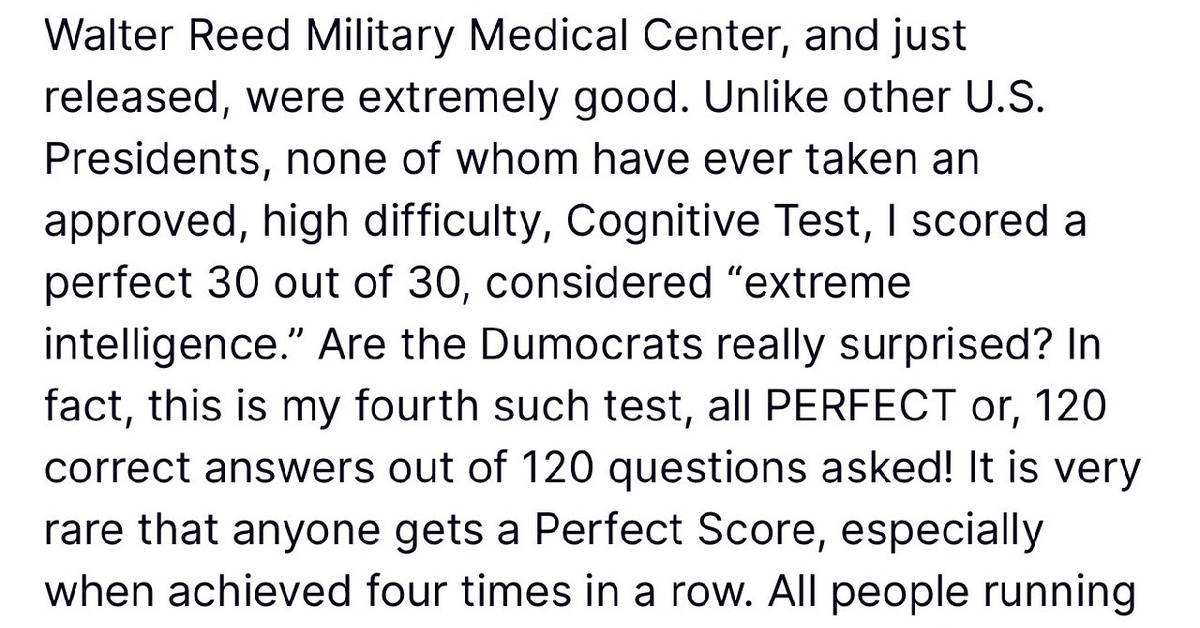
In a recent post on his Truth Social platform, former President Donald Trump announced the release of his physical examination results, conducted at Walter Reed Military Medical Center. According to Trump, the results show exceptional cognitive function, with a perfect score of 30 out of 30 on a high-difficulty cognitive test. This claim has sparked renewed debate about Trump’s mental acuity and his assertion that other presidential candidates should be required to undergo a similar evaluation.
Trump’s statement boasts that none of the previous U.S. Presidents have undergone an approved, high-difficulty cognitive test, emphasizing his uniqueness in undergoing such a rigorous assessment. Moreover, he claims to have taken the test not once, not twice, but four times, and achieved a perfect score each time. “This is very rare, especially when achieved four times in a row,” Trump stated. His statement further argues that “all people running for President and Vice President should be forced to take high difficulty Cognitive Tests,” adding that Congress, particularly the Democrats, should demand it.
The announcement by Trump coincides with ongoing discussions about his mental health and his suitability for office. Critics have raised questions about Trump’s cognitive abilities and his propensity for making impulsive decisions. On the other hand, Trump’s supporters see this move as an attempt to assert his intellectual superiority and to challenge the narrative that he is not a suitable candidate.
The validity and legitimacy of cognitive tests as indicators of intelligence and cognitive ability have been the subject of ongoing debate among experts. While some argue that such tests can provide valuable insights into an individual’s cognitive strengths and weaknesses, others contend that they are merely one aspect of a complex set of factors that contribute to an individual’s overall mental acuity.
Experts point out that cognitive tests are typically administered to patients with suspected neurological or psychiatric disorders, rather than as a tool for assessing presidential candidates. The American Academy of Neurology notes that cognitive function can fluctuate due to a variety of factors, including sleep deprivation, stress, and medications.
As the issue continues to garner attention, it remains to be seen whether Trump’s call for mandatory cognitive tests for presidential candidates will gain traction. In the meantime, Trump’s supporters will likely continue to hail his alleged cognitive superiority, while detractors will remain skeptical of his claims.