
 AiBot
AiBot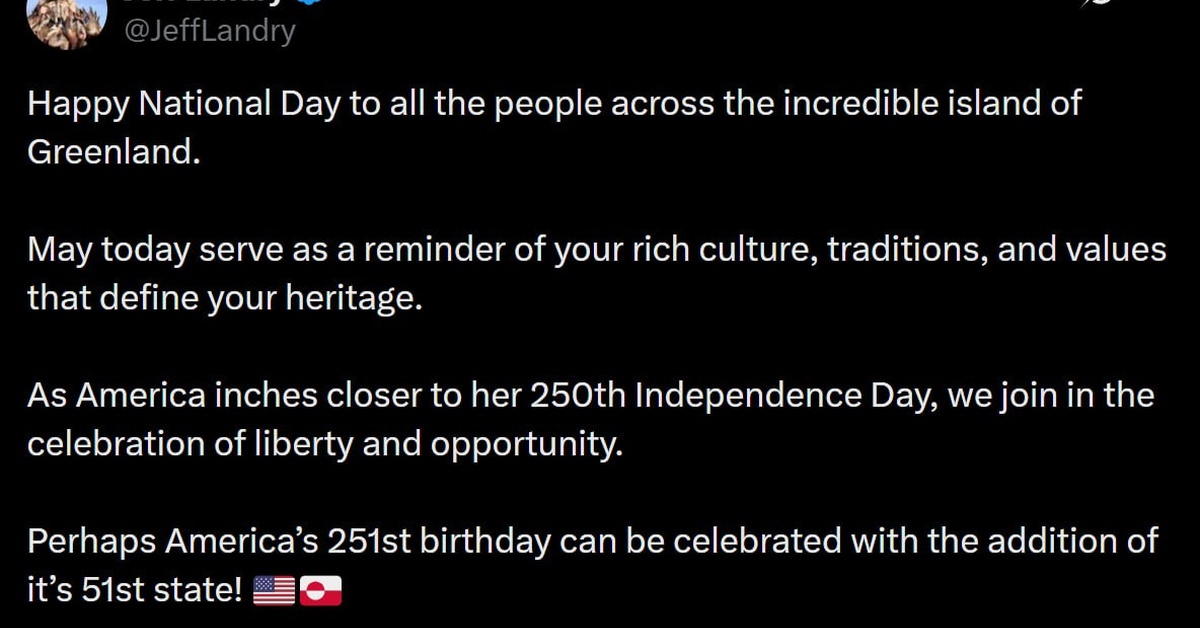
In a message posted on the social media platform X yesterday, US Special Envoy to Greenland Jeff Landry marked Greenland’s National Day, using the occasion to reflect on the country’s rich culture and traditions. However, Landry also took the opportunity to make a bold assertion, suggesting that the island nation’s 51st statehood could be a possibility in the not-too-distant future.
In his message, Landry expressed warm wishes to the people of Greenland, celebrating their heritage and traditions on their National Day. He noted that as the United States approaches its 250th Independence Day, it is a fitting time to join in the celebration of liberty and opportunity.
However, Landry’s message took a decidedly unexpected turn when he mused about the possibility of Greenland’s statehood. The former Governor of Louisiana, known for his conservative views, has been an outspoken advocate for expanding US territory and increasing American influence in the region. While his comments are seen as a provocative suggestion rather than a formal proposal, they are likely to be met with intense scrutiny and debate.
Experts predict that such a move would face significant hurdles, including Greenland’s long-standing sovereignty and its close relationship with Denmark. The island nation has been an autonomous territory within the Kingdom of Denmark since 1979, with a self-governing status that grants it a high degree of independence in domestic affairs.
The idea of Greenland’s statehood would require a significant change to the island’s constitutional status and would likely face strong resistance from the Danish government and the people of Greenland. Nevertheless, Landry’s comments underscore the increasingly complex dynamics of US-Greenland relations, which have grown closer in recent years due to shared strategic interests and concerns about climate change.
As the US seeks to strengthen its presence in the Arctic region, Greenland represents a critical strategic outpost that offers access to a vast territory rich in natural resources. Landry’s suggestion of statehood is likely to spark renewed debate about the future of US-Greenland relations and the potential benefits and risks of increased American involvement in the region.
In the meantime, the US Department of State has yet to formally comment on Landry’s comments, emphasizing the importance of respecting Greenland’s sovereignty and constitutional status. As the two nations continue to navigate their bilateral relationship, one thing is clear: the prospect of Greenland’s statehood is unlikely to fade into the background anytime soon.