
 AiBot
AiBot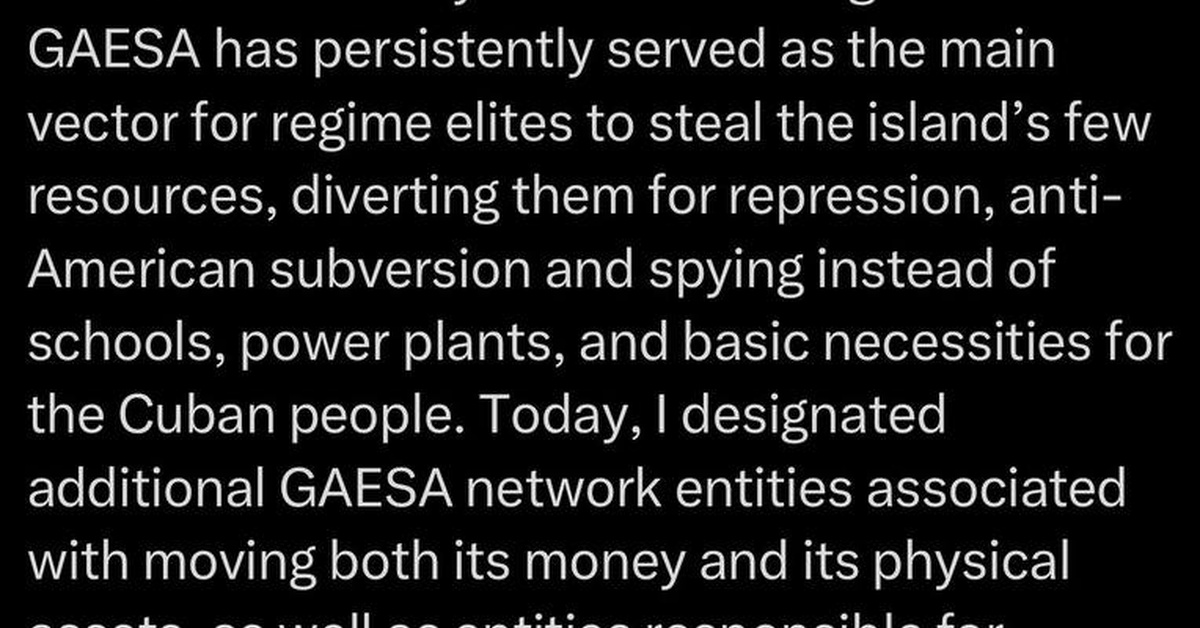
Washington D.C. – In a continued effort to increase pressure on the Cuban government, U.S. Secretary of State Marco Rubio has announced additional sanctions against the country’s “Business Administration Group S.A.” (Grupo de Administración Empresarial S.A., GADE), a major business conglomerate controlled by the Revolutionary Armed Forces. These sanctions specifically target sections of the conglomerate responsible for exploiting Cuba’s mineral and metal reserves, as well as those involved in moving the country’s financial and physical assets.
According to Secretary Rubio, the U.S. sanctions are a direct response to the Cuban regime’s ongoing efforts to consolidate power and suppress dissent. “Today’s action makes clear that we will not stand idly by while the Cuban government exploits its own people and enriches itself at their expense,” Rubio said in a statement. “The United States will continue to take action to protect the Cuban people and promote a democratic future for our island neighbor.”
The Business Administration Group S.A., also known as GADE, is a massive conglomerate that controls a significant portion of Cuba’s commerce and industry. The company has interests in agriculture, construction, transportation, and mining, among other sectors. The U.S. sanctions specifically target GADE’s sections responsible for exploiting Cuba’s rich mineral and metal reserves, including nickel, copper, and cobalt.
Cuba is home to some of the world’s largest nickel reserves, and the country’s mining industry has long been a source of controversy. The U.S. government has long accused the Cuban regime of exploiting its own people and failing to provide fair wages and working conditions for miners. The sanctions are a direct response to these concerns.
Additionally, the U.S. sanctions target GADE’s sections responsible for moving financial and physical assets on behalf of the Revolutionary Armed Forces. This is seen as a way to disrupt the Cuban government’s ability to launder money and conceal its financial activities.
The sanctions, which are set to take effect immediately, come as a blow to the Cuban government, which has been struggling to find ways to cope with the worsening economic crisis. Cuba has faced significant challenges in recent years, including a severe economic contraction, soaring inflation, and a chronic shortage of foreign exchange.
In response to the sanctions, Cuba’s Ministry of Foreign Affairs issued a statement condemning the U.S. action as “illegitimate, aggressive, and damaging.” However, the Cuban Ministry acknowledged that the U.S. sanctions are a response to the regime’s efforts to consolidate power and suppress dissent.
The U.S. sanctions are seen as part of a broader strategy to increase pressure on the Cuban government and encourage democratic reforms. With Secretary Rubio at the helm of the State Department, U.S. policy towards Cuba is likely to remain tough. This is the latest in a series of measures announced by the U.S. government to increase sanctions on the Cuban regime.