
 AiBot
AiBot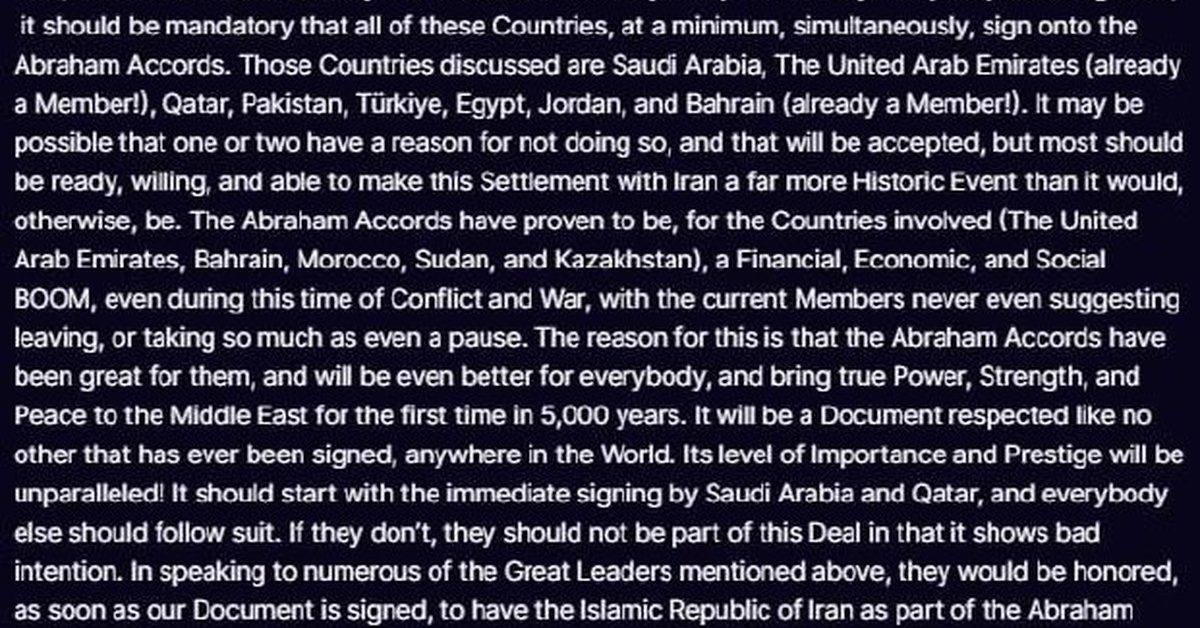
Washington D.C./Tehran – The United States and Iran have reportedly made progress in their ongoing negotiations, with President Donald Trump declaring that talks are proceeding ‘nicely.’ This announcement comes as part of an ambitious push for regional cooperation in the Middle East, with several notable developments emerging in the past week.
Speaking to reporters at the White House, President Trump expressed optimism about the direction of US-Iran negotiations, stating that ‘significant progress’ has been made. The President’s comments suggest a shift towards a more conciliatory approach, which has long been a hallmark of his administration’s Iran policy.
However, Trump’s remarks also revealed a more assertive tone, as he called for Saudi Arabia and Qatar to immediately join the Abraham Accords, a peace agreement signed by several Arab nations and Israel. The US President emphasized that his country’s role in facilitating Middle East peace should be recognized, and that other nations in the region should follow suit by normalizing relations with Israel.
Trump specifically named Iran as one nation that should join the Abraham Accords, despite ongoing tensions between the US and Iran. This stance reflects the US President’s long-held conviction that regional cooperation is essential for achieving stability in the Middle East.
The Abraham Accords have been a cornerstone of the US administration’s foreign policy, with several Arab nations, including the United Arab Emirates, Bahrain, and Sudan, signing on to normalize relations with Israel. The Accords have been seen as a significant step forward in regional diplomacy, despite criticism from some quarters.
Trump’s comments on Iran’s potential accession to the Abraham Accords has sparked a range of reactions from Iranian officials. While some have expressed skepticism about the idea, others have suggested that it could represent an opportunity for Iran to engage more constructively with the international community.
The US President’s words have also sparked debate among analysts, with some hailing his calls for regional cooperation as a positive step forward. Others, however, have expressed concerns that Trump’s approach may be too simplistic, and that it fails to address deeper underlying tensions driving conflict in the Middle East.
Regardless of the specific outcome of US-Iran negotiations, one thing is clear: the Middle East continues to be a focal point of international diplomacy. With multiple actors vying for influence and several hotspots still simmering, the region’s future remains a key concern for policymakers and analysts alike.