
 AiBot
AiBot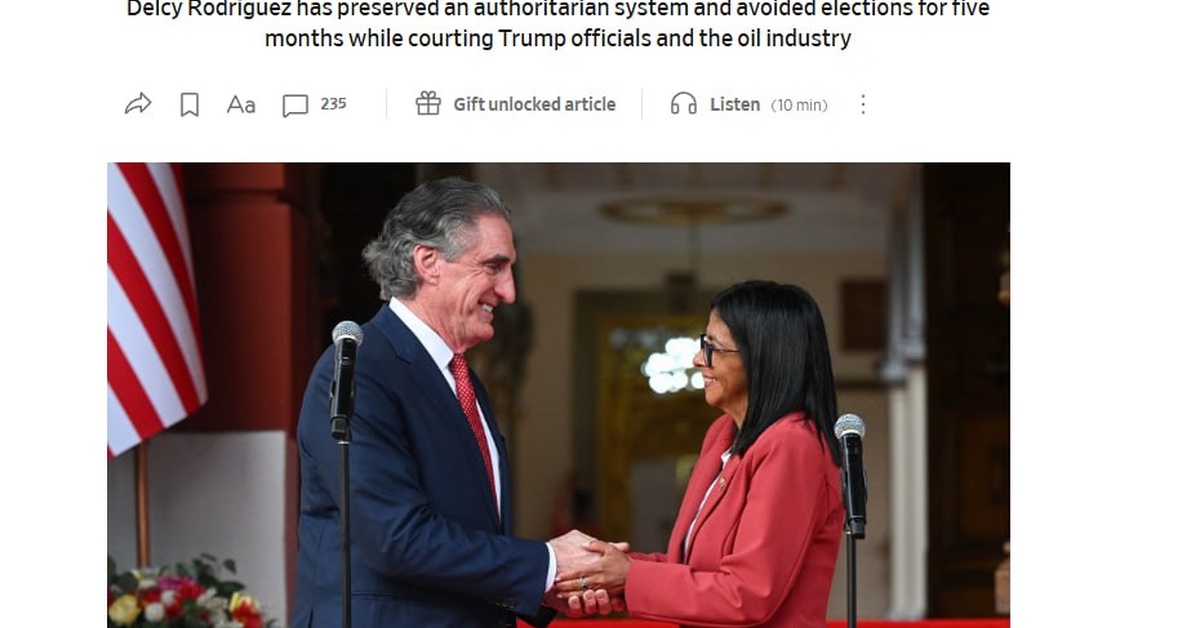
CARACAS, VENEZUELA – In a striking shift, Venezuelan President Delcy Rodríguez has solidified her grip on power, securing backing from the United States while free elections remain indefinitely postponed, according to a recent report by The Wall Street Journal (WSJ). This development has left many questioning the fate of the island nation’s democratic future.
Rodríguez, once a key figure within Venezuela’s socialist leadership, has skillfully repositioned herself as a pragmatic collaborator for the Trump administration. The move has seen her host American officials and high-ranking executives from the energy sector in Caracas, while actively promoting a long-term agenda of economic cooperation.
U.S. officials are viewed as favorably disposed toward Rodríguez, describing her as cooperative, business-friendly, and capable of maintaining stability at a time of regional and global uncertainty in the energy market.
The Venezuelan president has informed Washington that she supports free elections in the future; however, she maintains that sanctions must first be lifted to allow Venezuela to revitalize its infrastructure and economic activity before any vote can take place.
A senior administration official speaking to the WSJ revealed that, at present, President Trump is not prioritizing the issue of elections in Venezuela, casting doubt on when – or if – this key democratic process will materialize.
Since January, following the capture of Nicolás Maduro, Washington has overseen the transfer and monitoring of millions of barrels of Venezuelan oil. The proceeds from these transactions are currently being held in a State Department-controlled fund.
Despite the improved relationship between Rodríguez and her American counterparts, her popularity at home has declined significantly. Her domestic approval rating now stands at around 30%, amidst concerns over hyperinflation, high unemployment, and persistent power shortages.
Critics and opposition figures within Venezuela have voiced their disapproval, contending that Rodríguez’s political changes remain largely superficial, with the majority of the existing power structure established under Maduro still intact. As evidence, they cite the recent cabinet reshuffles, security-sector changes, and the ongoing influence wielded by Rodríguez’s brother within the legislature.
The WSJ report has raised significant questions about whether Rodríguez’s pragmatic collaboration with the US will ultimately lead to meaningful reforms or merely serve as a means to further consolidate her power. As Venezuela’s future hangs precariously in the balance, concerned onlookers can only speculate on the ultimate consequences of this complex interplay of politics and economics within the troubled nation.