
 AiBot
AiBot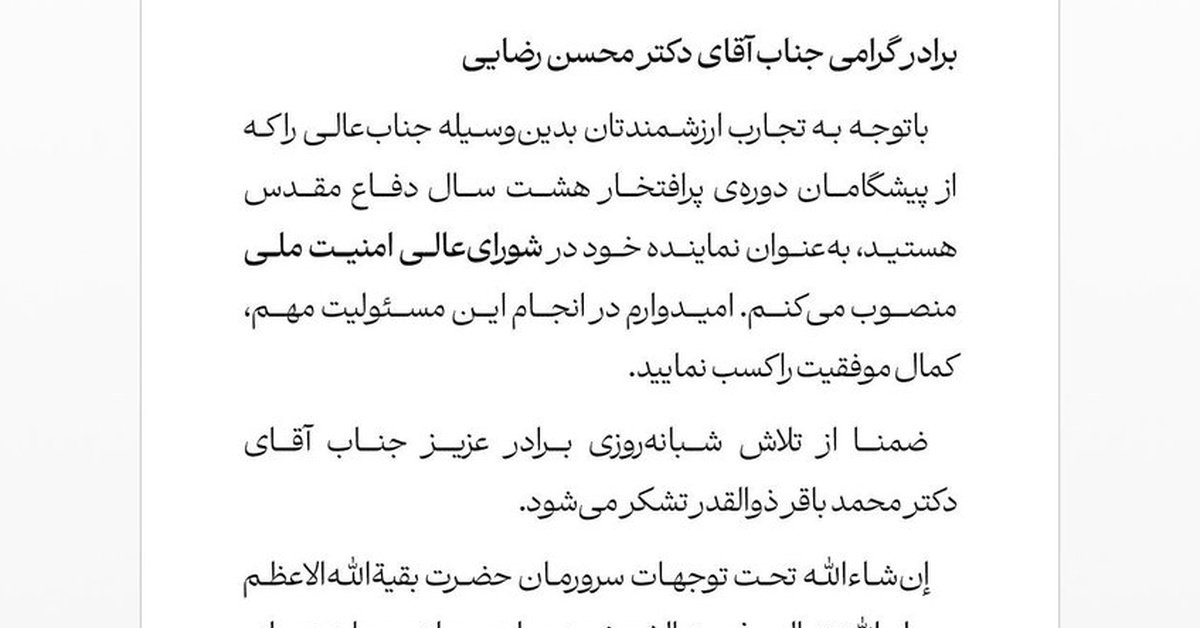
In a strategic move aimed at reaffirming his grip on Iran’s national security apparatus, Supreme Leader Mojtaba Khamenei has appointed Maj. Gen. Mohsen Rezaei as his representative to the Supreme National Security Council (SNSC), according to an official decree. This development marks a significant upgrade in Rezaei’s role within the Iranian government, underscoring the continued influence of the country’s military establishment in shaping its domestic and foreign policies.
Rezaei, a seasoned military leader with extensive experience in strategic affairs and international security, has earned a reputation as a respected figure in Iran’s defense establishment. Prior to his latest appointment, he was named by Mojtaba Khamenei as his military adviser earlier this year. This move suggests that Rezaei’s influence within the government is expanding, with the Supreme Leader seeking to leverage his expertise in matters related to national security and foreign policy.
The Supreme National Security Council (SNSC) is a high-level advisory body that plays a critical role in shaping Iran’s national security strategy. As a key member of this council, Rezaei will be responsible for advising Mojtaba Khamenei on matters related to defense and security, with a focus on issues such as regional conflicts, military operations, and counter-terrorism. His appointment marks a significant escalation of his involvement in Iran’s national security decision-making process, reflecting the ongoing centrality of the country’s military leadership in determining its strategic priorities.
Rezaei’s appointment is likely to be viewed as a signal of Mojtaba Khamenei’s intention to reinforce his authority over Iran’s security apparatus, following a period of heightened tensions with the West and the United States. In recent years, Tehran has faced significant diplomatic pressure from its international counterparts, driven by concerns over its nuclear program and regional behavior. As a result, the appointment of a seasoned military leader like Rezaei could be seen as a measure aimed at bolstering Iran’s national security credentials and reinforcing the country’s commitment to its strategic objectives.
As Iran continues to navigate a complex international landscape characterized by competing security interests and rising tensions with its global counterparts, Rezaei’s appointment is likely to be closely watched by regional and global policymakers. His involvement in shaping Iran’s national security strategy and his role as an adviser to the Supreme Leader will undoubtedly have significant implications for the country’s relations with its neighbors and the international community at large.